
Friendie
A library of AI companions for emotional support, coaching, and learning.
Tagline
Your judgment-free AI companion library
One app for emotional support, coaching, and learning
A warm alternative to cold chatbots and sterile apps
A coach in your pocket for the moments you need one
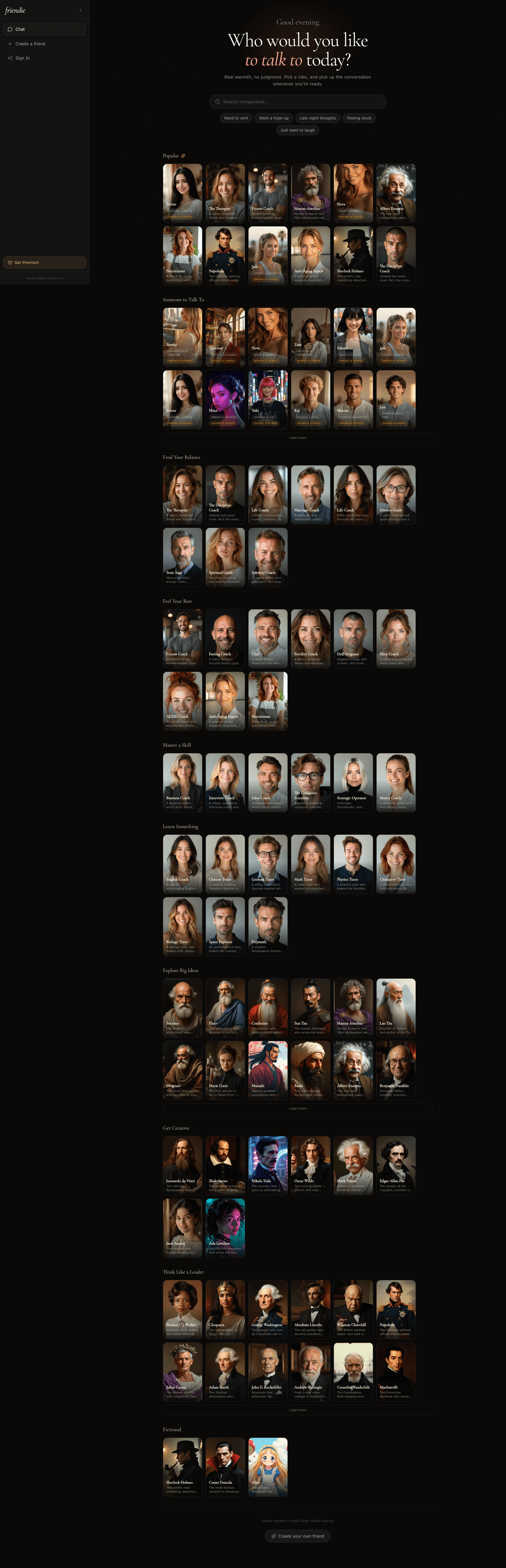
Friendie is a companion marketplace: one app for emotional support, coaching, and learning.
The homepage is organized as a browseable library of personas across multiple life domains, so the strongest category definition is breadth plus role specificity, not just "AI chat."
The warm alternative to generic ChatGPT-style assistants and cold self-help apps.
The page repeatedly emphasizes tone and relationship language—"Real warmth, no judgment," "Friendie listens"—which differentiates it from utility-first tools and sterile chatbot interfaces.
Your judgment-free coach for the moments when you need a nudge, not a spreadsheet.
The companions are designed around high-frequency emotional and habit problems like sleep, discipline, ADHD, sobriety, money, and relationships; that is a pain-killer frame, not a novelty frame.
Primary user
Consumers looking for emotionally supportive AI chat companions for nightly venting, motivation, and advice
ICP #1
25-34-year-old knowledge worker using AI at night after work to decompress
Pain
They want to vent or sort through feelings without burdening friends, but generic chatbots feel flat and disposable.
Why this solves
Friendie’s mood-based companion selection and "Friendie remembers" positioning make it feel like a returning conversational space instead of a one-off chatbot.
ICP #2
Self-improvement obsessed solo professional trying to build better habits without hiring a coach
Pain
They need practical nudges for sleep, fitness, nutrition, discipline, and money, but don’t want another sterile app with checklists.
Why this solves
The app bundles highly specific coach personas like Sleep Coach, Fitness Coach, Nutritionist, and Money Coach into one chat-first interface that lowers friction and feels more human than habit trackers or generic AI assistants.
ICP #3
Student or early-career builder who uses AI for study help and thinking through problems
Pain
They need on-demand explanations that adapt to their level, but standard tutoring tools are too narrow or too formal.
Why this solves
Friendie offers subject-specific tutors and thinkers like Math Tutor, Physics Tutor, Computer Scientist, and Polymath, giving them a conversational way to learn without switching between separate tools.
Strengths
- +The breadth of use cases is immediately obvious; it’s not just "friends," it’s coaches, tutors, and philosophical characters.
- +The mood-based shortcuts like "Need to vent" and "Feeling stuck" are strong because they map to real entry intents, not product features.
- +The persona descriptions are vivid and sticky, which makes the catalog feel less like software and more like a cast of characters.
Weaknesses
- −The page is trying to be too many products at once: companion app, therapy-ish tool, tutor marketplace, and life coach library. That weakens the core promise.
- −It leans heavily on character descriptions but gives almost no proof of quality, memory, safety, or outcomes.
- −There is no obvious explanation of how conversations work, what premium unlocks, or why users should trust the system with emotional topics.
- −The homepage lacks a single dominant CTA hierarchy; "Chat," "Create a friend," "Sign In," and "Get Premium" all compete.
- −Some personas feel dangerously adjacent to regulated categories like therapy, divorce, and sobriety without any boundary-setting or disclaimers.
Fix these
- Pick a sharper wedge for the homepage: either "the best AI companions" or "AI coaches for life and learning"; right now it’s both and therefore fuzzier than it should be.
- Add trust signals above the fold: memory behavior, privacy stance, safety boundaries, and what "Premium" actually includes.
- Create use-case landing pages for the highest-intent jobs: venting, ADHD, sleep, relationships, interview prep, and language learning.
- Replace some generic character tiles with evidence-oriented proof: example conversations, before/after outcomes, or testimonials tied to a specific persona.
- Clarify differentiation versus Character.AI and Replika by emphasizing structured coaching and learning, not just role-play conversation.
Drop-in replacement copy
Headline
AI companions for real life
Vent, coach, learn, and think out loud with companions that remember you.
Find the right voice fast
Browse companions by mood, goal, or topic instead of staring at a blank box. Start with Need to vent, Feeling stuck, or Want a hype-up.
Keep the conversation going
Friendie remembers context so you don’t have to repeat yourself every time. It feels less like a disposable chatbot and more like a place you return to.
Use AI for more than tasks
Get support for sleep, ADHD, fitness, nutrition, money, learning, and relationships in one app. The experience is chat-first, warm, and built for real moments.
Create a companion that fits you
If none of the built-ins match, make your own friend with the style and role you want. It’s a faster way to get something personal without writing a prompt from scratch.
FAQ
Is Friendie therapy?
No. Friendie is a companion and coaching product, not a replacement for a licensed therapist or emergency support. For mental health crises, users should contact local emergency services or a qualified professional.
What does Friendie remember?
Friendie remembers conversation context to make future chats feel continuous. You should be clear in-product about what is stored and give users control over their data.
How is this different from ChatGPT or Character.AI?
Friendie is organized around mood and goal, with specific companions designed for emotional support, coaching, and learning. The point is a better starting point and a warmer experience, not a blank prompt.
What do I get with Premium?
Premium should clearly unlock the things power users care about most, such as more chats, richer companions, memory depth, and media features. Spell that out plainly on the pricing page.
Who is this for?
People who want something more human than a sterile app and more useful than a generic chatbot. That includes night-time decompressing, self-improvement, tutoring, and thinking through life stuff.
Most AI chatbots feel disposable. Friendie is different: a library of 80+ AI companions for venting, coaching, learning, and late-night thoughts. It remembers you. It listens. It feels like a place, not a prompt.
I built the app I wanted at 1am. Not a sterile assistant. Not a fake friend. A place to vent, get unstuck, and talk to a coach who remembers what matters. That’s Friendie.
80 AI companions was the easy part. The hard part is making each one feel useful, warm, and not like the same chatbot in a costume. We’re tuning memory, tone, and outcomes now. This is what makes Friendie different.
People don't want more AI. They want: - someone to vent to - a nudge to go to sleep - help with ADHD spirals - a tutor that doesn't make them feel dumb Friendie is for those moments.
At night, generic AI sucks. You want to decompress, not debug prompts. You want warmth, not productivity theater. Friendie gives you companions for venting, coaching, and thinking out loud.
Your friends are not your therapist. And a spreadsheet is not a coach. Friendie sits in the middle: judgment-free conversations for the stuff you keep circling back to.
Need a better first chat? Open Friendie, pick a mood like "Feeling stuck" or "Need to vent," and jump into a companion built for that exact moment. No setup. No blank page. Just start talking.
Watch how memory changes everything. Most bots restart every time. Friendie remembers context, so the conversation keeps going like a real relationship instead of a reset button.
The best feedback is simple: "I used it instead of doomscrolling." "I came back the next night." "It actually helped me think." That’s the bar for Friendie.
Users don't ask for more features. They ask for better conversations. That’s why Friendie is built around specific companions: Sleep Coach, ADHD Coach, Math Tutor, Marcus Aurelius, Sherlock Holmes, and more.
Angle: Positioning Friendie as a companion marketplace, not just another AI chat app
I think most AI companion products are missing the real market. People don’t just want “chat.” They want a specific kind of conversation for a specific moment. At 11pm, they want to vent without feeling annoying. At 7am, they want a nudge to get moving. At 2pm, they want help thinking through a problem. That’s why we built Friendie as a library of AI companions instead of one generic assistant. You can browse by mood, goal, or topic: - Need to vent - Feeling stuck - Want a hype-up - Sleep help - ADHD support - Tutoring The bet is simple: people don’t want one AI that tries to do everything poorly. They want a place with the right voice for the right job. We’re still tightening the product, but this is the direction that feels real. Warmth matters. Specificity matters. Memory matters. If you’ve seen other AI products that feel too flat, I’d love to hear what actually made them unusable.
Angle: Why warm, judgment-free AI beats sterile productivity tools for habits and emotional support
There’s a weird gap in software right now. On one side, you have productivity apps that feel like spreadsheets with notifications. On the other, you have chatbots that are technically impressive but emotionally empty. Most people live in the gap between those two. They need help with sleep, discipline, motivation, ADHD spirals, money stress, relationship confusion, or late-night overthinking. And in those moments, they don’t want a dashboard. They want a voice. Friendie is built around that idea: real warmth, no judgment, and companions that feel useful instead of performative. We’re seeing that the best experiences are often not the most advanced ones. They’re the ones that feel safe enough to come back to. That’s the product thesis. Not “AI for everything.” More like “AI that feels like the right person in the right moment.” I’m curious how others are thinking about emotional trust in AI products. What makes you come back to one conversation app and not another?
Angle: How structured personas create better outcomes than a blank chatbot prompt
One thing we learned building Friendie: Blank chat is a terrible UX for most people. Yes, power users can craft perfect prompts. But most users don’t want to engineer a conversation. They want to choose a starting point and get value fast. So instead of asking people to figure out what to type, we give them a companion: - Sleep Coach for winding down - Fitness Coach for getting moving - Nutritionist for meal decisions - Math Tutor for learning on demand - Sherlock Holmes for playful reasoning - Marcus Aurelius for perspective That structure changes the experience completely. It lowers friction. It makes the product feel curated. It gives people permission to use AI for real life, not just tasks. The bigger lesson for me: a good AI product is not always about giving users more freedom. Sometimes it’s about giving them a better frame. If you’re building in AI, what do you think matters more: open-ended flexibility or strong opinionated starting points?
No visuals for this kit yet.
Tagline
AI companions for support, coaching, and learning
Description
Browse 80+ AI companions for venting, motivation, habit help, tutoring, and role-play. Friendie remembers context, feels warmer than generic chatbots, and gives you the right voice for the moment.
Maker's first comment
I built Friendie because I kept hitting the same wall with AI chat products: they were useful, but emotionally flat. At night especially, I didn’t want a blank prompt or a productivity tool pretending to be supportive. I wanted something that felt like a real place to talk, decompress, get unstuck, or learn something without starting from zero every time. Friendie started as a simple idea: what if AI was organized around the moment you’re in, not the feature list? That led us to mood-based entry points, specific companions like Sleep Coach, ADHD Coach, Math Tutor, and historical personalities, plus memory so conversations don’t reset like a disposable app. We’re shipping this in public and learning fast. I’d love feedback on which use cases feel most valuable, where the product feels too broad, and what would make you trust it more for personal conversations.
Pinned maker comment
We’d love feedback on the homepage wedge: should Friendie lead as an AI companion marketplace, or as AI coaches for life and learning? Also curious which companions feel most useful versus too gimmicky.
Meta
People don’t want another chatbot.
Hypothesis: knowledge workers who decompress at night will respond better to a warm companion app than a generic AI assistant. Friendie gives you AI companions for venting, motivation, sleep, ADHD, and learning — with memory so the conversation keeps going.
Google Search
AI companion for venting, coaching, learning
Hypothesis: people searching for emotional support, habit help, or tutoring want a specific companion, not a blank chatbot. Friendie offers 80+ AI companions organized by mood and goal, including sleep coach, ADHD coach, and Math Tutor.
Reddit Promoted
Blank chat is a bad default.
Hypothesis: indie makers, AI users, and self-improvement nerds are more likely to try a structured companion library than another general chatbot. Friendie lets you pick a mood or goal and start with a companion built for that moment.
Subreddits
r/SideProject
Build-in-public post about shipping a companion marketplace and what people actually wanted: venting, sleep, ADHD, tutoring
Rules: Show the product, share what you learned, avoid hype, and don’t spam multiple posts
r/indiehackers
The positioning challenge of building an AI product that is warm instead of generic
Rules: Founder story and lessons only; no obvious ad copy
r/EntrepreneurRideAlong
Journey post on iterating from generic AI chat to structured companions with moods and memory
Rules: Share progress, results, and what you’re testing; keep it transparent
r/selfimprovement
How people use AI for sleep, discipline, ADHD, and accountability without feeling judged
Rules: Be careful with self-promo, lead with usefulness, and frame it as a discussion
r/ChatGPT
Structured AI companions as a better UX than prompting from scratch for everyday help
Rules: Must be genuinely useful; show the workflow and avoid “check out my app” energy
Communities
Post one transparent build log per week: what users asked for, what changed, and what you learned about emotional trust.
Only post when you have a sharp technical or product insight, like memory design or why blank chat is a bad UX.
Engage before launch by commenting on other AI products and asking for feedback on positioning and onboarding.
Cold outreach template
{firstName}, saw your post about {context} and it reminded me of what we’re building with Friendie. It’s an app with AI companions for venting, coaching, and learning, and I’d love your blunt take on whether it feels useful or too broad. If you’re open, I can send you a 60-second demo.
Product Hunt timing
Launch on Tuesday at 12:01am Pacific Time. That gives you a full day of US traffic, avoids Monday noise, and fits the ICP of knowledge workers and makers who browse Product Hunt during work breaks and after hours.
Indie Hackers post ideas
- 01Why we switched from a single AI assistant to a companion library
- 02What users actually want from emotional AI at night
- 03How we’re testing trust, memory, and safety in a consumer AI app
Competitor alternatives
Current tone of voice
Warm, playful, and slightly aspirational with a human-first emotional tone; for example, "Real warmth, no judgment" and "The voice in your head that won't let you quit".
Your kit is ready. Sign up free to unlock, takes 10 seconds.
7 more X posts · 2 LinkedIn · Product Hunt copy · ad hooks · 100-user playbook · landing critique