
Friendie
An AI companion marketplace for chatting, coaching, and structured self-help.
Tagline
One app for venting, coaching, and practice
Every mood gets its own AI companion.
Stop juggling five apps for one better life.
Open it at 1 a.m. and get unstuck.
Friendie is the AI companion marketplace where every mood, goal, and topic has a dedicated personality.
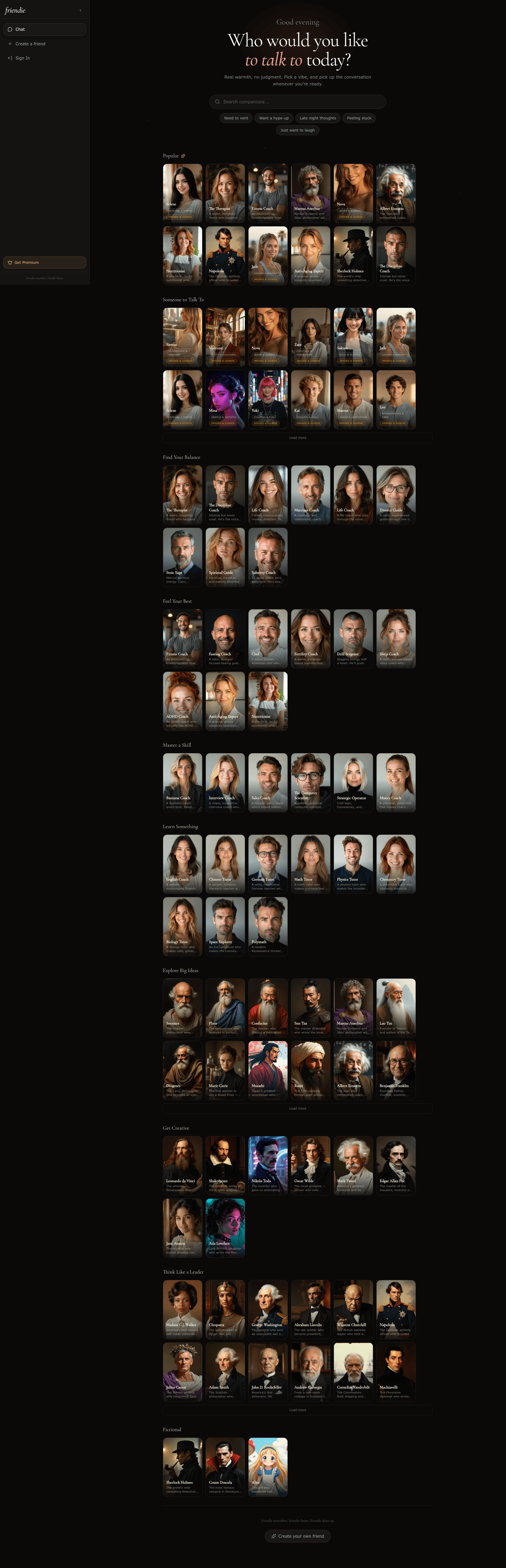
This is the strongest category-defining angle because the product is clearly not just one chatbot; it is a curated catalog of specialized personas spanning emotional support, coaching, and learning
The alternative to juggling Therapy, Calm, Duolingo, and YouTube advice in five different apps.
The breadth of companions makes consolidation a compelling story. The page already frames multiple use cases across balance, skills, and learning, so bundling is a real differentiator
A judgment-free AI you can open at 1 a.m. when you need to vent, get unstuck, or get back on track.
The homepage copy leans heavily into emotional immediacy and low shame: 'Real warmth, no judgment' and mood prompts like 'Late night thoughts' and 'Feeling stuck' are ideal pain-killer hooks
Primary user
Consumers looking for low-friction emotional support and advice between private, late-night, or in-between moments
ICP #1
Lonely Gen Z or younger millennial woman using her phone at night after work
Pain
She wants to vent, feel seen, or get a hype-up without burdening friends or paying for therapy
Why this solves
Friendie’s mood-based entry points and 'warm, no judgment' positioning make it easy to start a conversation instantly, and the 'Friendie remembers' promise gives it continuity that generic chatbots lack
ICP #2
Self-improvement hobbyist who already uses apps like Calm, Headspace, and YouTube coaching content
Pain
They bounce between disconnected tools for sleep, fitness, nutrition, discipline, and money advice and never build momentum
Why this solves
Friendie bundles specialized companions by life area, so one app can handle sleep, fasting, nutrition, ADHD, money, and discipline without switching contexts
ICP #3
Student or early-career professional preparing for interviews, learning languages, or leveling up technical skills
Pain
They need repetition, instant feedback, and a non-embarrassing place to practice answers or concepts
Why this solves
The Interview Coach, English/Chinese/German tutors, Math/Physics/Chemistry/Biology tutors, and Computer Scientist persona give them always-available practice with a conversational format instead of static lessons
Strengths
- +Clear browsing model: users immediately understand they can pick a persona that fits a mood or need
- +Strong breadth of use cases across companionship, coaching, and education
- +Persona copy is vivid and memorable; 'The Therapist,' 'The Discipline Coach,' and 'Stoic Sage' are easy to grasp
Weaknesses
- −The page is almost all catalog and almost no proof; there are no testimonials, outcomes, or screenshots of the actual chat experience
- −The positioning is too broad and risks feeling like a novelty zoo instead of a product with a sharp promise
- −The 'AI friends' angle is emotionally interesting but also trust-sensitive; there is zero explanation of privacy, memory controls, or safety boundaries
- −Many personas blur together conceptually, and some feel like redundant variants of the same archetype
- −There is no obvious answer to 'why Friendie vs Character.AI or Replika' beyond having more categories
Fix these
- Lead with 3 flagship use cases instead of 80+ companions: venting, self-improvement, and learning
- Add concrete product proof: screenshots of memory, conversation continuity, and images/videos if that is a real capability
- Create comparison blocks against Character.AI, Replika, and Pi to explain the difference in one glance
- Clarify privacy, memory, and emotional-safety messaging so users know what data is stored and how the companion behaves
- Use outcome-based landing sections such as 'Get unstuck before bed,' 'Practice your interview answer,' and 'Build a better routine in 10 minutes a day'
Drop-in replacement copy
Headline
One app for every mood
Venting, coaching, tutoring, and practice with AI companions that remember.
Pick the right voice for the moment
Browse 80+ companions built for specific moods, goals, and roles. Open the one that fits what you need right now instead of starting from a blank chat.
Get unstuck in minutes, not tabs
Use Friendie for late-night venting, discipline, sleep, nutrition, ADHD, interview prep, and language practice. It replaces the usual pile of apps and half-finished advice.
Come back without repeating yourself
Friendie remembers context across chats so the conversation can continue. That makes it easier to track progress, keep momentum, and feel like you are actually getting somewhere.
Create a companion that fits your style
If none of the existing personas feel right, make your own. Shape the tone, role, and vibe around how you actually like to talk.
FAQ
Is Friendie a therapist?
No. Friendie is an AI companion app for support, coaching, and practice. It can help you vent, reflect, and structure your thoughts, but it is not a licensed therapist or a replacement for professional care.
How is this different from Character.AI or Replika?
Friendie is built around specialized companions for specific moods and goals, not just open-ended character chat. The focus is on getting unstuck, practicing skills, and moving between use cases in one place.
Does Friendie remember past conversations?
Yes, where memory is enabled, Friendie can keep context across chats so you do not have to start over every time. The goal is continuity, not creepy overreach.
Who is this for?
People who want low-friction emotional support, self-improvement guidance, or practice partners for interviews, languages, and technical topics. It is especially useful when you need something right now and do not want to wait.
Is my data private?
Friendie should clearly explain what is stored, what is remembered, and what you can control. If you are building the landing page, make the privacy and memory rules obvious before the first chat starts.
Most AI apps feel like one bland bot. Friendie is a marketplace of 80+ AI companions for venting, coaching, studying, and late-night overthinking. Need to vent? Feeling stuck? Want interview practice? Open a companion that fits the moment.
There are 80 AI friends here. Not because people need more chatbots. Because different moods need different voices. Friendie lets you pick a therapist vibe, a discipline coach, a tutor, or a hype friend in seconds.
I built this after midnight scrolling. People don't always want a productivity app. They want something to say when they're stuck, lonely, anxious, or trying to get their life together. So I made Friendie: a place to pick the exact companion for the moment.
The hardest part was not the chat. It was making each companion feel distinct enough that you instantly know which one to open. Mood-based entry points helped: Need to vent. Feeling stuck. Late night thoughts. That tiny UX choice matters more than people think.
Therapy is expensive. Friends are busy. Sometimes you just need to vent, get a reality check, or practice the thing you keep avoiding. Friendie gives you a private place to do that with companions built for specific moods, goals, and skills.
You don't need another self-help tab. You need one place for sleep, discipline, nutrition, ADHD, interview prep, and language practice. Friendie bundles the kinds of help people already search for across five apps and 20 YouTube rabbit holes.
Watch memory change the conversation. Friendie remembers what you said last time, so the next chat doesn't start from zero. That matters when you're building habits, tracking progress, or coming back after a rough day. This is what chat should feel like.
A 30-second interview practice loop. Open Interview Coach. Answer a tough question. Get pushed on weak spots. Try again. That's the whole point: less passive advice, more repetition with feedback.
People don't want a bot. They want relief. That has been the strongest pattern in early reactions: users aren't looking for novelty, they're looking for a low-friction way to feel seen, practice something hard, or get back on track.
The sticky part is the mood menu. Users don't browse for fun and leave. They come in with a feeling: stuck, overwhelmed, lonely, curious, behind. That makes the app feel less like a directory and more like a place to actually start.
Angle: positioning as a marketplace of specialized companions
I kept seeing the same thing: People do not want one generic AI that tries to be everything. They want the right voice for the moment. At night, that might mean someone to vent to. In the morning, it might mean a discipline coach. Before an interview, it might mean a practice partner that pushes back. That is why I built Friendie. It is an AI companion marketplace with 80+ companions across mood, coaching, tutoring, and roleplay. The product is not “chat with AI.” The product is “pick the right companion for the exact problem you have right now.” That framing matters. It makes the app easier to understand. It makes the use case clearer. And it avoids the trap most AI apps fall into: being technically broad but emotionally vague. The next step for me is not adding more personas for the sake of it. It is making the top 3 use cases unmistakable: - venting when you feel stuck - self-improvement when you need structure - practice when you need repetition If you were launching this, which one would you lead with?
Angle: why consolidation beats app juggling
A lot of people are already doing this manually. They use Calm for sleep. YouTube for advice. ChatGPT for random questions. Duolingo for language practice. Maybe a separate app for fitness, nutrition, or journaling. That is a terrible experience. Not because any one app is bad. Because context switching kills momentum. Friendie is my attempt at collapsing that mess into one chat-first place. Not one bot. One app with specialized companions for different jobs. That means: - a late-night companion when you need to vent - a coach when you want a routine - a tutor when you want practice - a role-based guide when you want to think out loud I think the real product insight is simple: people do not need more content. They need a faster path from feeling something to doing something about it. That is the bet. If you have ever bounced between five apps and still felt stuck, I built Friendie for you.
Angle: memory, trust, and emotional safety
There is a reason AI companion products live or die on trust. If the product forgets everything, it feels fake. If it overreaches, it feels creepy. If it is vague about what it stores, people bounce. So I spent a lot of time thinking about the basics: what gets remembered, how continuity works, and how the app should behave when someone is using it for emotional support rather than entertainment. That part is easy to underestimate. People do not just want a fun persona. They want consistency. They want to come back later and not repeat themselves. They want the companion to feel warm without pretending to be a human. Friendie is built around that tension. It should feel personal. It should be useful. And it should be clear that it is still software. If you are building in this space, I think the trust layer matters more than the persona layer. The persona gets attention. The trust gets retention. I would love feedback on how to make that clearer on the landing page without killing the vibe.
No visuals for this kit yet.
Tagline
AI companions for every mood and goal
Description
Browse 80+ AI companions for venting, coaching, tutoring, and practice. Open the right voice for the moment, get memory across chats, and keep moving when you're stuck.
Maker's first comment
I built Friendie because I kept noticing the same pattern in my own life and in other people’s: we do not always need a big productivity system, we need a place to start. Sometimes that means venting after a bad day, sometimes it means practicing an interview answer, and sometimes it means getting a nudge to go to sleep, eat better, or stop doom-scrolling. Most AI tools try to be one universal assistant. That never felt emotionally right to me. So I built Friendie as a marketplace of specialized companions — different moods, different voices, different jobs. The goal is simple: open the app, pick the right companion, and get unstuck faster than you would by juggling five apps or waiting to text a friend back. The hardest part has been making the experience feel warm without becoming vague, and useful without becoming clinical. I’d love feedback on whether the top use cases are clear enough, and whether the memory/continuity angle feels trustworthy from the first screen.
Pinned maker comment
I’m especially looking for feedback on one thing: does Friendie feel like a clear product, or just a big catalog of personas? If you have thoughts on the homepage, the top 3 use cases, or how to make memory/privacy feel reassuring fast, I want to hear it.
Meta
Targeting lonely late-night scrollers who need relief.
Hypothesis: women 18-34 who use their phone at night will respond to a judgment-free AI companion more than a generic chatbot. Friendie gives them a private place to vent, get a hype-up, or get unstuck with a companion that fits the moment.
Google Search
Searching for interview practice or self-help?
Hypothesis: people already searching for interview prep, language practice, sleep help, or ADHD coaching want one app instead of five. Friendie bundles specialized AI companions so they can practice, reflect, and improve in chat.
Reddit Promoted
Sick of bouncing between five self-improvement apps?
Hypothesis: indie-minded users who already use Calm, Duolingo, YouTube advice, and ChatGPT will try a consolidated AI companion app if it feels practical, not gimmicky. Friendie gives you mood-based companions for venting, coaching, and practice.
Subreddits
r/SideProject
Build-in-public post showing the app catalog, mood-based entry points, and what you learned about emotional support vs utility
Rules: Share what you built and learned, not just a link; keep it honest; use the weekly showcase if available; avoid spammy repeated promotion
r/indiehackers
Founder story about why one generic bot was not enough and how you turned it into a marketplace of companions
Rules: No pure ads; focus on lessons, traction, product decisions, and ask for feedback
r/microsaas
Position Friendie as a niche consumer product with a sharp UX lesson: mood-first entry points drive activation
Rules: Must be relevant to small software businesses; value-first posts work best; avoid obvious promo language
r/EntrepreneurRideAlong
Share a transparent launch diary and ask how other founders would market an emotional-support AI product
Rules: Keep it founder journey focused; be direct about metrics, experiments, and progress; no low-effort launch drops
r/Entrepreneur
Conversation starter about whether consumers will pay for AI companionship plus coaching in one product
Rules: Needs to be genuinely useful or discussion-driven; promotional posts are often removed; frame it as a question or lesson
Communities
Post a build log, then reply thoughtfully to every comment. Focus on product decisions, not sales.
Engage with other launches for 2 weeks before launch day, then ask for feedback from makers who understand consumer AI.
No Code Founders Discord
Share screenshots, ask for UX feedback on onboarding and personas, and offer to review other members' landing pages first.
Cold outreach template
Hey {firstName} — saw {context} and thought of Friendie, a chat-first AI companion app for venting, coaching, and practice. If you ever want a judgment-free place to get unstuck at night or rehearse something hard, I’d love to get your take. Mind if I send you a quick demo?
Product Hunt timing
Launch on Tuesday at 12:01 a.m. Pacific Time. Tuesdays tend to be strong for consumer product discovery, and a U.S.-friendly midnight PT launch gives you the full day for comments while also catching Europe in the morning and North America through the day.
Indie Hackers post ideas
- 01Why I stopped building one AI assistant and turned it into a companion marketplace
- 02What I learned from testing mood-based onboarding for a consumer AI app
- 03How I’m thinking about trust, memory, and retention in AI companionship
Competitor alternatives
Current tone of voice
Warm, intimate, and lightly theatrical with personality-led copy like 'Friendie remembers. Friendie listens.' and 'Real warmth, no judgment.'
Your kit is ready. Sign up free to unlock, takes 10 seconds.
7 more X posts · 2 LinkedIn · Product Hunt copy · ad hooks · 100-user playbook · landing critique