
SaaS Idea
Scans Reddit and X for validated B2B pain points and scores SaaS opportunities.
Tagline
Find painful SaaS ideas before building
Bloomberg-style monitoring for SaaS opportunities
Replace founder guesswork with real pain signals
Score B2B pain, not random startup ideas
The Bloomberg Terminal for SaaS ideas.
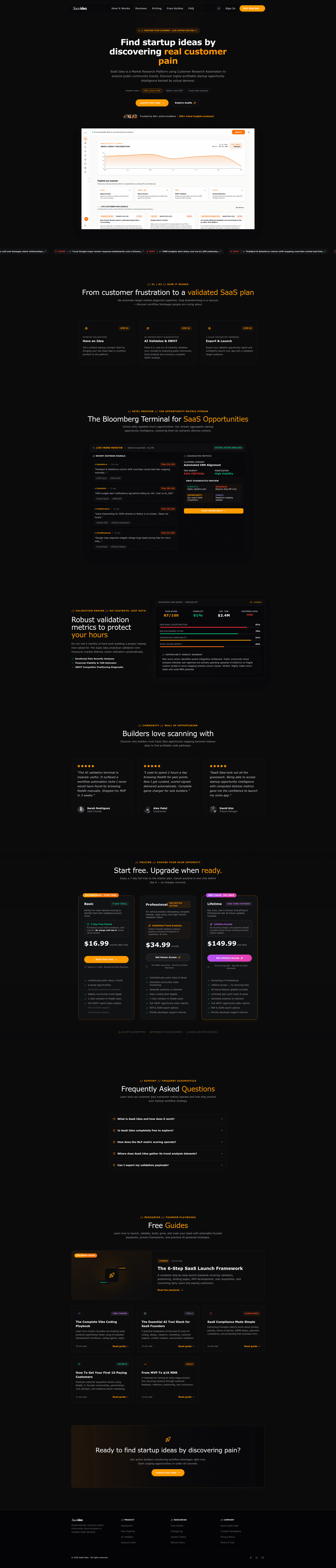
The page explicitly uses this analogy and supports it with live trend scanning, clustered signals, and a dashboard-like opportunity stream. It works because the product feels like a monitoring terminal, not a brainstorming tool.
Alternative to building in a vacuum with no signal.
The strongest promise here is replacing founder guesswork with public pain evidence. The page repeatedly attacks 'brainstorming in a vacuum' and emphasizes validated demand from real posts.
Pain-first SaaS validation, not idea generation.
The product is better framed as a validation engine than an idea spinner: it scores pain, estimates willingness to pay, runs SWOT, and exports reports. That makes it more credible than generic idea generators or ChatGPT prompts.
Primary user
Solo founder or indie hacker validating a B2B micro-SaaS idea before building
ICP #1
Solo founder building a B2B micro-SaaS with no existing audience
Pain
They waste days scraping Reddit, X, and niche forums manually, then still can't tell whether the pain is strong enough to justify building.
Why this solves
SaaS Idea automates the scan, clusters repeated complaints, and assigns pain/viability/TAM scores so the founder can pick a niche with evidence instead of vibes.
ICP #2
Product manager at an early-stage startup evaluating side-hustle or spinout ideas
Pain
They need a fast way to pressure-test ideas and produce a defensible rationale for stakeholders or their own conviction.
Why this solves
The app packages public complaints into a SWOT-style opportunity report and exportable validation payload, which is much easier to socialize than a raw pile of screenshots.
ICP #3
Agency owner or consultant spotting repeatable workflow pain in client ops
Pain
They see the same integration, reporting, and admin headaches across clients but struggle to know which one can become a productized SaaS.
Why this solves
The platform highlights recurring pains like CRM column drift or Google Maps review response costs and ranks them by severity and monetization potential, which helps identify productizable patterns.
Strengths
- +The page makes the core job-to-be-done instantly obvious: find painful, repeated B2B problems and validate them quickly.
- +It uses concrete examples that feel real, like AWS budget alert delays, HubSpot/Salesforce column drift, and Notion SOP transcription.
- +The dashboard-style language and metrics give the product a tangible, data-heavy feel rather than a fluffy AI vibe.
Weaknesses
- −The copy overuses pseudo-finance jargon and generic AI validation language, which makes the product sound more theatrical than trustworthy.
- −The numbers feel invented without enough methodological credibility; 'Pain Score 87/100' and '$2.4M TAM' appear with no explanation of how they are calculated.
- −The page says it sources from Reddit and X, but doesn't show sampling method, freshness guarantees, or data coverage by niche, which will create skepticism.
- −The target user is muddled between indie hackers, PMs, and serial entrepreneurs; it needs a sharper wedge and use-case narrative.
- −There is too much repetition of the same idea across sections, and not enough proof of actual outcomes like ideas found, builds launched, or revenue generated.
Fix these
- Tighten the positioning around one primary buyer: indie founders validating their next micro-SaaS idea in under 10 minutes.
- Add methodological transparency for scores: show what inputs drive Pain Score, Viability, and TAM so the metrics feel defensible.
- Replace some of the vaporwave terminal copy with specific workflow screenshots: query, cluster, score, export, outreach.
- Show before-and-after case studies of real opportunity discoveries, including the posts scanned, the niche chosen, and the result.
- Differentiate against GummySearch and Exploding Topics by emphasizing pain scoring, SWOT, and exportable validation reports rather than broad trend discovery.
Drop-in replacement copy
Headline
Find painful SaaS ideas fast
Scan Reddit and X, score the pain, and pick a niche worth building.
See which pains repeat
SaaS Idea scans public conversations for the same complaint showing up again and again. That helps you separate one-off noise from real demand.
Rank ideas by signal
Every cluster gets a pain score, viability estimate, and TAM range so you can compare opportunities quickly. No more guessing which idea sounds better.
Get a report you can use
Export your findings as PDF or JSON and share them with cofounders, clients, or yourself. The report gives you a clean way to justify the bet.
Jump from pain to outreach
See who is talking about the problem and reach out to a few users directly. That turns abstract research into real conversations fast.
FAQ
Where does the data come from?
Public posts and comments from Reddit and X. The product looks for recurring B2B complaints, workflow friction, and buying signals.
How are the scores calculated?
Scores are based on repetition, urgency, workflow impact, and signs the person might pay for a fix. The goal is to make the logic visible, not magical.
Is this for idea generation or validation?
Validation first. It helps you decide whether a pain is strong enough to build on before you write code.
Who is this for?
Solo founders, indie hackers, PMs, and agency owners who want to spot small B2B problems that can become SaaS products.
What makes this different from trend tools?
Trend tools show what is popular. SaaS Idea shows what hurts enough to potentially pay for a fix.
Founders keep building blind. I built SaaS Idea to scan Reddit + X for real B2B pain, cluster repeated complaints, and score which problems are actually worth solving. No brainstorming. No vibes. Just painful posts, opportunity themes, and validation reports.
I stopped trusting startup ideas that only sounded smart. Now I want receipts: - repeated pain - clear buyer - signs of urgency - enough mentions to matter That’s what SaaS Idea pulls from Reddit and X before you write a line of code.
Manually scouting Reddit is a trap. You waste hours reading complaints, save 40 tabs, and still don’t know if the pain is real or just noise. SaaS Idea turns those posts into clustered opportunities with pain scores, SWOT, and exportable reports.
This is what validated pain looks like: 1. scan Reddit + X 2. cluster repeated complaints 3. score pain and viability 4. export a report Example themes: AWS budget alerts, CRM sync drift, Notion SOP transcription. That’s the product.
The best B2B SaaS ideas usually don’t start as ideas. They start as repeated complaints from people trying to get work done. If the same pain shows up across threads, comments, and posts, that’s signal. SaaS Idea finds the repeats.
I built the anti-brainstorming tool. SaaS Idea scans public complaints on Reddit and X, groups them into opportunity themes, then scores the pain so you can decide what to build without guessing. If you build micro-SaaS, this is your first filter.
Most SaaS ideas die in research because research is messy. Too many screenshots. Too much noise. No clear way to compare one pain against another. I wanted a terminal that turns scattered complaints into ranked opportunities. So I built one.
What if your next idea already exists as 200 complaints on Reddit? That’s the shortcut. Find the repeated pain, see who is complaining, estimate whether they’d pay, then build the smallest thing that fixes it.
Search pain, not keywords. SaaS Idea looks for workflow bottlenecks, broken integrations, admin hell, and recurring frustration across Reddit + X. Then it scores the opportunity so you can stop collecting random startup ideas and start choosing.
Validated demand beats cleverness. A clever SaaS with no pain is a hobby. A boring SaaS with urgent pain is a business. SaaS Idea exists to help founders tell the difference before they build.
Angle: pain-first validation for solo founders
Most early SaaS ideas fail because founders start with a solution. They build a tool, then go looking for a problem. That is backwards. The better path is to start with repeated pain, then ask: - Is this happening often enough? - Is the person likely to pay? - Is the workaround annoying enough to replace? That is why I built SaaS Idea. It scans Reddit and X for public B2B complaints, clusters them into themes, and scores each opportunity by pain, viability, and estimated market size. The goal is simple: help solo founders validate a micro-SaaS idea before writing code. Not with vague “market research.” Not with a pile of screenshots. With a report that shows: - what people are complaining about - how often it appears - what the likely wedge is - whether it looks worth building I think there is too much building in a vacuum right now. Too many founders are guessing. I wanted a faster way to answer: should I build this, or walk away? That is the job. And if you are a founder choosing your next project, you probably need the same filter.
Angle: methodological transparency and credibility
One thing I do not trust in startup tools: fake precision. A random “Pain Score 87/100” with no explanation is just theater. So with SaaS Idea, I wanted the scoring to feel defensible. The product scans public Reddit and X conversations, groups similar complaints together, and then evaluates the theme using simple signals: - repetition - urgency language - workflow disruption - buyer fit - signs of willingness to pay From there it produces a validation report with: - pain score - viability estimate - TAM estimate - SWOT-style summary - source posts behind the cluster The point is not to pretend the future is certain. The point is to make the reasoning visible. If a founder is going to bet weeks or months on an idea, they should be able to see why it ranked well. That is also why I think a lot of “idea generators” miss the mark. Ideas are cheap. Evidence is not. This is for people who want evidence.
Angle: positioning against broad trend tools
There are already plenty of tools that tell you what is trending. I wanted something more specific: what pain is repeated enough that a micro-SaaS could win? That is the difference. SaaS Idea is not trying to be a general trend dashboard. It is a pain-first validation tool for founders who want to build something small, useful, and profitable. It scans Reddit and X, clusters complaint patterns, and turns them into ranked opportunities like: - CRM sync drift - AWS budget alert delays - Notion SOP transcription - review-response bottlenecks Then it packages that into exportable reports so you can decide fast. I think this matters because most indie builders do not need more inspiration. They need fewer bad bets. If you are building a B2B micro-SaaS, the real question is not “what is hot?” It is “what pain is loud enough to pay for?” That is the question this tool is built to answer.
No visuals for this kit yet.
Tagline
Reddit and X pain scoring for SaaS ideas
Description
SaaS Idea scans Reddit and X for repeated B2B pain, clusters it into opportunity themes, and scores each one with pain, viability, and TAM estimates. Built for founders who want evidence before code.
Maker's first comment
I built SaaS Idea because I kept seeing founders do the same thing I did: spend days hunting for ideas, save a pile of screenshots, and still not know whether the pain was real enough to build on. The core problem is not finding ideas. It is filtering noise. A lot of promising SaaS projects are hiding inside public complaints on Reddit and X, but it is painful to manually sort them, compare them, and decide if they are worth betting on. So this product scans those conversations, clusters repeated pain, and turns them into a validation report with pain score, viability, TAM estimate, SWOT, and source posts. I made it for solo founders and indie builders who want to pick a niche with evidence instead of vibes. Would love feedback on two things: whether the scoring feels credible, and whether the reports help you decide faster. If you try it, tell me what kind of pain you want it to find better.
Pinned maker comment
I’m especially looking for feedback on the scoring logic, report usefulness, and whether the first-time experience makes the signal obvious fast.
Meta
Stop building SaaS ideas from vibes.
Hypothesis: solo founders will convert if we show them a faster way to validate B2B pain before building. SaaS Idea scans Reddit and X, clusters repeated complaints, and scores which problems look worth solving. If you’re hunting your next micro-SaaS, this is the filter.
Google Search
Find SaaS ideas from Reddit pain
Hypothesis: founders searching for micro-SaaS ideas are looking for evidence, not inspiration. SaaS Idea pulls public complaints from Reddit and X, groups them by theme, and ranks pain, viability, and TAM so you can decide faster. Built for solo founders validating before code.
Reddit Promoted
Most startup ideas die in research.
Hypothesis: indie hackers will click when the ad speaks to their biggest failure mode: wasting time on weak ideas. SaaS Idea scans Reddit and X for repeated B2B pain, clusters it into opportunity themes, and scores each one so you can choose a niche with actual signal.
Subreddits
r/SideProject
Share the product as a tool for validating side projects before building, with one real example of a clustered pain theme.
Rules: No pure promotion; lead with what you learned, include screenshots or a short teardown, and keep the post useful to builders.
r/indiehackers
Post a build log about replacing guesswork with Reddit/X pain signals and ask for feedback on scoring credibility.
Rules: Must be founder-relevant, share process and numbers, avoid hype, and frame it as a lesson rather than an ad.
r/microsaas
Show how the tool helps find small, monetizable B2B pains that can become micro-SaaS wedges.
Rules: Stay specific, avoid generic self-promo, and focus on niche ideas and validation methods.
r/EntrepreneurRideAlong
Document the journey of turning public pain into a ranked opportunity list and invite critique on methodology.
Rules: Use a real update style, no link dumping, and make the post about the process and results.
r/startups
Share the problem of idea validation noise and explain how you’re using public complaints as a filter for B2B opportunities.
Rules: High bar for self-promo, so lead with insight, data, and a concrete example; keep it non-salesy.
Communities
Post build logs, validation findings, and one sharp lesson per week. Comment on other founders’ idea-validation threads before mentioning the product.
Join conversations about niche selection, customer discovery, and pricing. Offer the scoring framework as a discussion point, not a pitch.
Participate where founders talk about shipping fast and finding problems. Share scans and opportunity themes as examples of how you choose what to build.
Cold outreach template
Hey {firstName} — saw {context} and it made me think of a tool I built for finding repeated B2B pain on Reddit/X before you waste time building. If you’re still exploring ideas, I can run a scan for your niche and send you the report. Want me to do that?
Product Hunt timing
Launch on Tuesday at 12:01am Pacific Time. That gives you a full day of PH traffic, catches US builders early, and hits the ICP when they are actively browsing before work and during their morning product hunt.
Indie Hackers post ideas
- 01I replaced startup idea brainstorming with Reddit pain scoring
- 02How I cluster complaints into micro-SaaS opportunities
- 03What makes a SaaS idea feel validated before code
Competitor alternatives
Current tone of voice
Punchy, hackerish, and faux-financial-terminal styled, with lines like "The Bloomberg Terminal for SaaS Opportunities" and "NO CHATBOTS. JUST DATA."
Your kit is ready. Sign up free to unlock, takes 10 seconds.
7 more X posts · 2 LinkedIn · Product Hunt copy · ad hooks · 100-user playbook · landing critique