
Matchmind
AI coach that pressure-tests World Cup bets before you place them.
Tagline
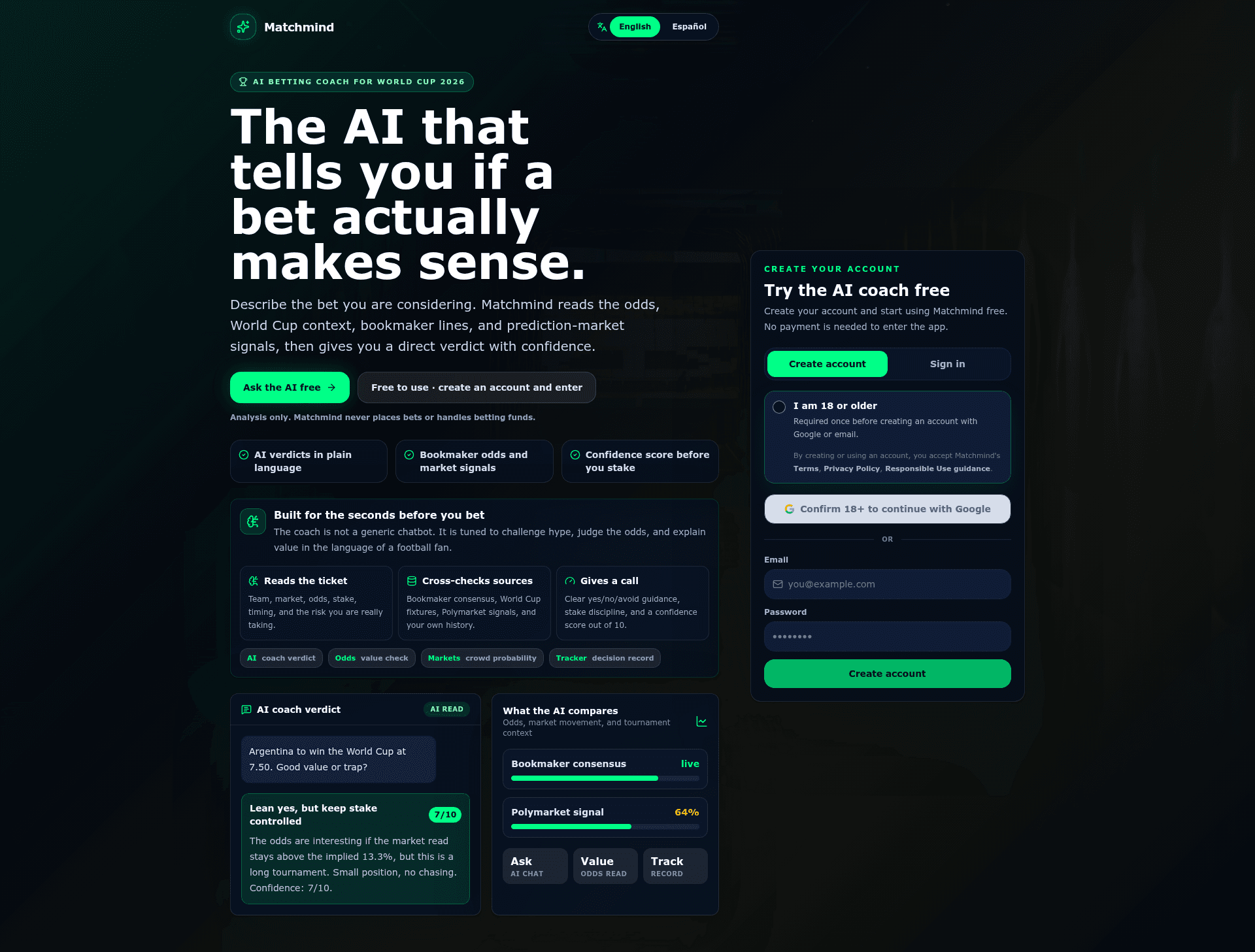
The AI that tells you if a bet makes sense
Before you bet, get the anti-hype verdict.
Odds, market signal, and context in one call.
Stop making bets you can't explain later.
The anti-hype betting coach for World Cup 2026.
This is the clearest category-defining frame because the page repeatedly emphasizes challenging hype, judging odds, and giving direct verdicts rather than being a generic AI chatbot.
A second opinion that combines sportsbook odds with prediction-market signals.
The product’s visible differentiation is the blend of bookmaker consensus and Polymarket signals, which is meaningfully sharper than most sportsbook-side tools that only show odds.
Stop making bets you can't explain after five seconds.
The core value is decision clarity at the moment of action: plain-language verdict, confidence score, and stake discipline. That makes it a pain-killer for impulsive betting, not just an information tool.
Primary user
Football bettors who wager on World Cup markets and want a second opinion before placing a bet
ICP #1
Recreational football bettor who places pre-match World Cup bets on sportsbooks like Bet365 or DraftKings
Pain
They get swept up by hype, especially on big-tournament favorites, and often cannot tell whether a price is actually good value or just feels good.
Why this solves
Matchmind is built specifically for the seconds before the bet: it reads the ticket, checks the odds against market and tournament context, and gives a simple verdict instead of forcing the user to interpret raw data.
ICP #2
Value bettor who already watches odds movement and follows prediction markets like Polymarket
Pain
They spend too much time triangulating bookmaker consensus, market movement, and game context across multiple tabs before deciding whether to stake.
Why this solves
Matchmind collapses those inputs into one decision layer, explicitly showing bookmaker consensus, Polymarket signal, and a confidence score so the user can move faster without abandoning their process.
ICP #3
Social bettor or football content consumer who bets based on narrative, pundit takes, and fan sentiment
Pain
They are vulnerable to overbetting popular teams and long-shot tournament outcomes because they lack a disciplined way to challenge their instincts.
Why this solves
The product’s explicit value-check framing and stake-discipline language is designed to puncture hype and nudge users toward smaller, more controlled positions when the edge is weak.
Strengths
- +The offer is instantly understandable: ask before you bet, get a verdict, and don't chase bad tickets.
- +The page shows concrete product behavior with a sample bet on Argentina to win at 7.50, which makes the product feel real rather than abstract.
- +The page does a good job clarifying trust boundaries by stating that Matchmind never places bets or handles betting funds.
Weaknesses
- −The positioning is too narrow and seasonal; it screams World Cup 2026, which limits perceived utility outside the tournament.
- −The landing page over-indexes on feature claims and under-explains why its verdicts are better than a user checking odds, Polymarket, and ChatGPT themselves.
- −There is no proof: no accuracy examples, no win/loss track record, no testimonials, no case studies, and no explanation of how the confidence score is calibrated.
- −The page does not tell users what data sources it actually pulls from beyond broad labels like bookmaker consensus and Polymarket signals.
- −The product sounds useful, but the landing page does not yet build enough trust for betting advice, where users will demand evidence and transparency.
Fix these
- Lead with a sharper use case headline: 'Before you place a World Cup bet, get a value verdict in 10 seconds.'
- Add a visible methodology section showing exactly how odds, market movement, fixtures, and user history influence the verdict.
- Publish example outputs for several common bet types: outright winner, match result, total goals, and both teams to score.
- Add credibility signals such as decision accuracy, calibration, or a sample backtest on past World Cup markets.
- Expand the product narrative beyond World Cup 2026 to 'football betting coach' so the brand can survive after the tournament ends.
Drop-in replacement copy
Headline
Before you bet, get the verdict
Paste a World Cup bet and get a blunt yes, no, or avoid.
Stop betting on vibes
Matchmind pressure-tests the ticket before you place it. You get a plain answer instead of having to interpret charts, odds screens, and hot takes on your own.
See the price in context
It checks bookmaker consensus, match context, and tournament dynamics so you can tell whether a price is actually good or just looks attractive.
Use crowd signal without getting fooled
Polymarket signals help show where the crowd sits, but the verdict still challenges hype instead of blindly following it. That means less noise and fewer emotional bets.
Build better habits over time
Your bet history helps surface patterns in your decisions, so the product can nudge you toward smaller stakes when the edge is weak. It’s analysis only, built to improve decisions, not place them.
FAQ
Does Matchmind place bets for me?
No. It only analyzes bets and returns a verdict. It never places wagers or handles funds.
What does the confidence score mean?
It’s a quick read on how strong the verdict is based on the inputs available: odds, market context, tournament context, crowd signal, and your history. It’s not a guarantee.
What kinds of bets does it work on?
It’s built for common football markets like outright winner, match result, totals, and BTTS-style bets. The more specific the bet input, the better the output.
Why not just ask ChatGPT?
You can, but Matchmind is built for this exact decision: it’s tuned to compare bookmaker odds, tournament context, and crowd signal before giving a direct call.
Is this only for the World Cup?
Right now the product is focused on World Cup 2026 because that’s where the strongest use case is. The bigger goal is a football betting coach that can expand beyond the tournament.
World Cup bets need a second opinion. Built Matchmind: an AI coach that reads your bet, checks odds + market context + Polymarket signal, then says yes / no / avoid. It never places bets. It just tells you if the ticket actually makes sense.
I tested an Argentina bet in 10 seconds. Input: market, odds, stake, timing. Output: "lean yes" + confidence score + why the price looks wrong/right. That's the product: less guessing, fewer hype bets, faster decisions.
Most bettors are shopping for reassurance, not insight. They already have 8 tabs open: odds, injury news, stats, Twitter, Polymarket. Matchmind collapses all that into one call: yes, no, or avoid.
Built for the 5 seconds before you click place bet. That’s when bad decisions happen. Matchmind pressure-tests the ticket first, so the bet feels boring when it should feel boring.
Early users keep asking one thing: "Would you actually take this bet?" That’s the whole product. A plain answer, a confidence score, and a reason you can understand without becoming an odds nerd.
Betting apps don't stop bad bets. They make them easier. Matchmind is the thing you open before the sportsbook: paste the bet, get a verdict, keep your stake small when the edge is weak.
Yes, no, or avoid is the only interface that matters here. Not a wall of charts. Not more jargon. Just: does this World Cup bet make sense, and how confident should I be?
If you can't explain the bet in one sentence, you probably shouldn't place it. Matchmind is built to catch those moments: the popular side, the too-good price, the wager you only like because everyone else does.
The hardest part isn't the model. It's turning betting noise into a direct answer a human will trust. So Matchmind says the quiet part out loud: lean yes, lean no, or avoid entirely.
People don't want more data here. They want fewer dumb bets. That’s why Matchmind combines bookmaker consensus, tournament context, Polymarket, and your own history into one verdict.
Angle: anti-hype betting coach
I built Matchmind because betting gets dumb right before the click. You look at a World Cup price, see a narrative you like, and suddenly the bet feels obvious. It rarely is. Matchmind is an AI coach that pressure-tests the bet before you place it. You paste in the market, odds, stake, and timing. It gives you a plain answer: yes, no, or avoid — plus a confidence score. What I like about this framing is that it’s not trying to be another analytics dashboard. It’s a decision tool. The goal is not to flood you with more data. The goal is to stop you from making a bet you’ll have to rationalize later. It cross-checks sportsbook odds, match and tournament context, Polymarket signals, and your own decision history. And it’s explicit about what it is: analysis only, no betting, no funds. If you bet on football markets and care about not getting swept up by hype, this is for you. I’m looking for people who want to break it. If you’d use a tool like this, tell me what would make you trust it.
Angle: value bettor workflow
A lot of value bettors already do the same annoying routine: 1. Check odds. 2. Check movement. 3. Check context. 4. Check prediction markets. 5. Ask themselves if they’re overthinking it. Matchmind is built to compress that workflow into one decision layer. You describe the bet. It reads the ticket, pulls in bookmaker consensus, World Cup context, Polymarket signal, and your own history, then gives you a direct verdict and confidence score. The interesting part is not that it shows more data. It’s that it forces a decision. That matters because the real problem isn’t access to information. It’s decision fatigue. If you’re a football bettor who already lives in odds screens and prediction markets, I think the right product is the one that helps you move faster without pretending certainty exists. That’s what I’m building. Curious: would you rather see a sharper backtest, a clearer methodology page, or more example outputs first?
Angle: explainable decisions for recreational bettors
Most recreational bettors don’t need more picks. They need a better way to challenge the bets they already want to place. That’s the idea behind Matchmind. It’s an AI coach focused on World Cup betting that gives a simple yes / no / avoid call before you stake. The user can input team, market, odds, stake, and timing. The system then cross-checks bookmaker consensus, match and tournament context, Polymarket signals, and the user’s own history. I think the strongest product here is not “AI for betting.” It’s “stop making bets you can’t explain five seconds later.” That’s a much more useful promise. The product is also very clear about boundaries: it analyzes bets, it does not place them, and it does not handle funds. I’m interested in building something people can actually trust in a category where trust is scarce. If you were the target user, what would you need to see on the landing page before trying it?
No visuals for this kit yet.
Tagline
AI coach for World Cup bets
Description
Paste a World Cup bet and get a straight verdict: yes, no, or avoid. Matchmind checks sportsbook odds, tournament context, Polymarket signals, and your own history before you stake.
Maker's first comment
I built Matchmind for the exact moment when betting goes from fun to sloppy: the few seconds before you click place bet. If you bet on football, you know the feeling. You’ve got the odds open, maybe a stats tab, maybe a prediction market tab, maybe a friend’s hot take in your head. The ticket starts to feel good because it feels familiar, not because it’s actually good. Matchmind is my attempt to replace that noise with a simple pressure test. You describe the bet, and it gives you a direct verdict — yes, no, or avoid — plus a confidence score and the reasoning behind it. It looks at bookmaker consensus, match and tournament context, Polymarket signal, and your own decision history. I’m launching it as analysis only. It never places bets and never touches funds. I want it to be the thing that helps people skip dumb bets, not the thing that adds more hype. Would love feedback on the trust layer, the verdict format, and what would make you actually use it before a wager.
Pinned maker comment
I’d especially love feedback on whether the verdict format is clear enough, and what proof would make you trust the confidence score.
Meta
Targeting football bettors who hate bad tickets
Hypothesis: recreational World Cup bettors will use a pre-bet coach if it gives a blunt yes/no/avoid call instead of more charts. Matchmind reads the bet, checks odds + tournament context + Polymarket signal, then pressure-tests it before you stake.
Google Search
World Cup bet calculator? Not quite.
Hypothesis: searchers looking for odds tools want a faster decision, not another spreadsheet. Matchmind checks bookmaker consensus, match context, and crowd signal, then tells you if the bet makes sense in plain English.
Reddit Promoted
If you’re about to place a World Cup bet, pause.
Hypothesis: bettors in football and betting communities will try a tool that challenges their bet before they fire it. Matchmind is a free AI coach that gives a yes / no / avoid call with a confidence score and no bankroll handling.
Subreddits
r/footballbetting
Share a useful breakdown of how to sanity-check World Cup bets before staking, with a live demo of the verdict format.
Rules: Check self-promo rules first; lead with value and examples, not a product pitch.
r/soccer
Post a discussion about how fans can avoid hype-driven tournament bets, with the tool framed as a decision aid.
Rules: This sub is strict on promotion; ask a genuine question and keep the product mention minimal.
r/Betting
Explain the workflow problem of comparing odds, market signal, and context across tabs, then show how you solved it.
Rules: No spam, no affiliate language, no guaranteed-winning language.
r/sportsbook
Share a short case study of a bet verdict on a World Cup market and invite people to critique the methodology.
Rules: Read sidebar rules carefully; stay factual and avoid direct sales language.
r/indiehackers
Tell the build story: why you made a betting decision assistant, how you validated the pain, and what feedback you need.
Rules: Founder updates do well if they include lessons, numbers, and transparent product screenshots.
Communities
Post the build story and the landing page teardown, then reply fast to every comment with specifics about the model, data sources, and trust boundaries.
Share launch lessons and acquisition experiments, not betting hype. Ask for feedback on the positioning and onboarding.
BettingTalk Discord
Join as a bettor first, share a few free example verdicts, and ask what would make the tool useful before ever linking the product.
Cold outreach template
Hey {firstName} — saw your {context} and thought of something I’m building. It’s called Matchmind: you paste a World Cup bet, and it gives you a yes / no / avoid verdict before you stake. If you’re open, I’d love your blunt take on whether this would actually help or just add noise.
Product Hunt timing
Launch on Tuesday at 12:01 AM PT. That gives you a full US day, catches Europe in the morning and Asia later, and fits an ICP that browses betting and football content across time zones. Tuesday avoids the weekend clutter and Monday backlog.
Indie Hackers post ideas
- 01I built an AI coach that tells you if a World Cup bet makes sense
- 02How I’d make bettors trust an AI verdict before they stake
- 03What I learned trying to turn betting chaos into a yes/no/avoid product
Competitor alternatives
Current tone of voice
Confident, plainspoken, and slightly sports-bet savvy, with lines like "The AI that tells you if a bet actually makes sense" and "Lean yes, but keep stake controlled."
Your kit is ready. Sign up free to unlock, takes 10 seconds.
7 more X posts · 2 LinkedIn · Product Hunt copy · ad hooks · 100-user playbook · landing critique