
URLDN
Track which links, posts, and campaigns actually drive results.
Tagline
Know which links actually win
Track every link like an experiment
A sharper Bitly for people who need attribution
Stop guessing. Know which channel converts
The link analytics layer that tells you which channel, post, and campaign actually works.
This is the clearest category-defining angle because the page repeatedly emphasizes moving beyond raw clicks to source, campaign, and conversion visibility.
A sharper alternative to Bitly when you care about performance, not just link shortening.
Bitly is the obvious incumbent for shortening and basic tracking, but URLDN’s pitch is more analytics-first: real-time tracking, campaign dashboards, UTM support, and link-in-bio.
Stop guessing which content drives traffic—track every shared link like an experiment.
The page’s strongest emotional hook is experiment-based decision-making, especially for Reddit, email, social, and ads. This frames the product as a painkiller for attribution ambiguity.
Primary user
Growth marketer or performance marketer managing multi-channel campaigns across social, email, ads, and community posts
ICP #1
Growth marketer at a B2B SaaS startup running Reddit, email, and paid social experiments
Pain
They know clicks by channel, but not which specific posts, links, or campaigns are pulling their weight. Their reporting is fragmented across UTM builders, spreadsheets, and whatever the ad platform says.
Why this solves
URLDN centralizes links and shows performance by source, device, geo, and campaign, so they can compare Reddit posts vs email vs ads from one dashboard and stop relying on guesswork.
ICP #2
Solo founder of a creator-led DTC or SaaS brand using link-in-bio, newsletters, and social posts
Pain
They need to squeeze more value out of every shared link but don’t have time for a complex analytics setup or a full marketing ops stack.
Why this solves
URLDN gives them a centralized way to create and manage trackable links, plus QR and campaign tools, so they can attribute traffic by asset and channel instead of treating every offline click as anonymous.
Strengths
- +The value proposition is crisp and outcome-oriented: it focuses on what drives results, not just clicks.
- +The feature set is easy to scan and maps well to real workflows: dashboards, campaign tracking, branded links, QR codes, and link-in-bio.
- +The examples are concrete enough to feel real, especially "Reddit posts," "email vs social vs ads," and "turn every shared link into a measurable experiment."
Weaknesses
- −It says "conversion funnels" in the meta description but never shows actual conversion tracking in the page content, which creates trust friction.
- −The product feels like a bundle of familiar link tools unless you explain the unique wedge; right now it sounds a lot like Bitly + Linktree + UTM tracking.
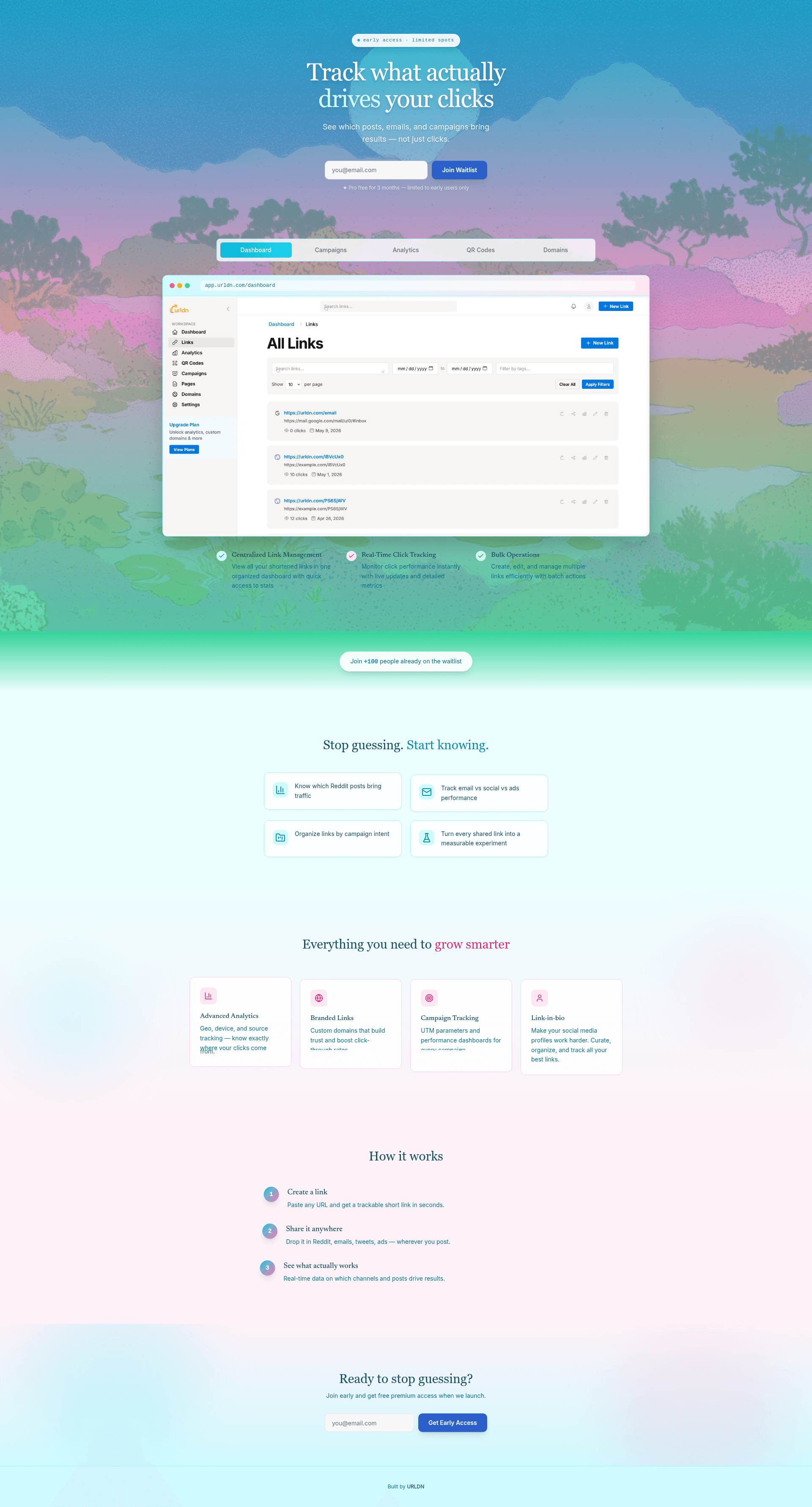
- −There’s no proof: no screenshots with metrics, no example dashboard outputs, no customer logos, and no quantified outcomes.
- −The page is too waitlist-heavy for a product this early; the CTA is clear, but there’s not enough substance to justify urgency beyond "3 months free Pro."
- −The audience is broad and somewhat fuzzy—marketers, creators, founders, and community folks all show up, which weakens specificity.
Fix these
- Reframe the homepage around one killer use case, such as "track Reddit, email, and social campaign performance in one place."
- Add a real dashboard screenshot with labeled metrics like source, geo, device, UTM campaign, and top-performing links.
- Clarify whether "conversion funnels" are real and, if so, show exactly what conversion events are supported.
- Position against Bitly more directly with a comparison block: shorter links, but also campaign-level analytics, branded domains, and link-in-bio.
- Narrow the primary ICP on the landing page to growth marketers or founders; keep creator use cases secondary so the message doesn’t dilute.
Drop-in replacement copy
Headline
Know which links actually win
Track posts, campaigns, and channels in one dashboard.
See what each campaign really did
Track clicks by source, campaign, geo, and device in real time. Compare Reddit, email, social, and ads without stitching together five tools.
Manage every link from one place
Create, edit, and organize links in a centralized dashboard. Bulk actions make it easy to keep large campaign sets clean.
Use branded links people trust
Add custom domains, UTM parameters, QR codes, and link-in-bio pages. Your links look cleaner and your reporting stays consistent.
Stop guessing and repeat winners
URLDN turns every shared link into a measurable experiment. When one post or placement outperforms the rest, you’ll know exactly where to double down.
FAQ
Is this just a link shortener?
No. URLDN shortens links, but the real value is performance tracking. You get campaign-level analytics, source breakdowns, and live click data.
Can I use my own branded domain?
Yes. You can connect branded custom domains so your short links look clean and consistent with your brand.
Does it support UTM tracking?
Yes. You can add and manage UTM parameters so your campaigns stay organized across channels and tools.
What kind of analytics do I get?
You can see live clicks, geo, device, source, and campaign performance in one dashboard. It is built for comparing what actually works.
Who is this best for?
Growth marketers, founders, and social/community teams who share links across Reddit, email, ads, and social and want clearer attribution.
Most link tools stop at clicks. That’s useless if you need to know which Reddit post, email, or ad actually pulled its weight. URLDN tracks links like experiments: source, device, geo, campaign, and live clicks in one dashboard.
Track every shared link now. URLDN turns short links into measurable experiments. Branded domains. UTM tracking. QR codes. Link-in-bio. If you run growth campaigns, stop guessing which placements work.
I built this after staring at a mess of UTM sheets, Bitly links, and ad dashboards. Clicks were easy. Answers were not. So I made URLDN: one place to manage links and see what actually drives traffic.
Reddit posts, email, ads. Same product. Different links. URLDN shows which one gets clicks by source, geo, device, and campaign in real time. That’s the difference between "more traffic" and "more of the right traffic."
One dashboard beats five tabs. That’s the whole point. Instead of bouncing between UTM builders, spreadsheets, and platform reports, URLDN keeps every link and campaign in one place. Less busywork. More signal.
UTMs are not attribution. They’re just labels if you never connect them to actual link performance. URLDN lets growth teams see which campaigns, sources, and placements are worth repeating.
Bitly tells you clicks. URLDN tells you what drove them. If your job is performance marketing, that difference matters a lot.
I kept hearing the same complaint from founders and marketers: "We know traffic is up. We don’t know what caused it." That’s the gap URLDN exists to close.
Live click tracking is addictive. You ship a link, post it, and watch the numbers move in real time. Then you can actually compare channels instead of arguing with gut feel.
If your links matter, measure them. That’s why we added branded domains, QR codes, link-in-bio pages, and bulk link ops. Same workflow. Better data.
Angle: Why link tracking needs to be more than clicks
Most teams do not have a traffic problem. They have a measurement problem. They publish on Reddit, send emails, run ads, post on X, share in communities, and then try to explain results from 5 different tools and a spreadsheet. You can see clicks. But can you tell which post, placement, or campaign actually worked? That is the gap URLDN is built to close. It gives growth teams one place to manage links and see performance by source, geo, device, and campaign in real time. So instead of asking: • Which channel won? • Which post drove traffic? • Which campaign deserves another dollar? You know. That is the product. Stop guessing. Start knowing.
Angle: Sharper Bitly alternative for performance marketers
Bitly is fine if you just want shorter links. But if you are running performance marketing, "fine" is not enough. You need to know which links, posts, and campaigns actually drive results. That is why we built URLDN. It is a link analytics layer for teams who care about attribution: • Branded domains • UTM tracking • Real-time click analytics • Geo, device, and source breakdowns • Bulk link management • QR codes and link-in-bio pages The goal is simple: turn every shared link into a measurable experiment. If a Reddit post outperforms email, you should see it. If one campaign is dead, you should kill it. If one placement prints traffic, you should repeat it. That is how good teams get sharper. Not with more dashboards. With better answers.
Angle: Founder story and the pain of fragmented attribution
I kept seeing the same pattern. Founders and growth marketers knew something was working. They just could not tell what. The stack looked like this: • UTM builder • Bitly or another shortener • Platform analytics • Spreadsheet for cleanup • More spreadsheets for reporting That is not a system. That is friction. So we built URLDN to make link tracking boring in the best way. One dashboard. One place for links. Live click tracking. Campaign performance. Clear source, device, and geo data. It is not trying to be a giant analytics suite. It is trying to answer a very specific question faster: which links, posts, and campaigns are worth doing again? If you have ever shipped a campaign and then spent an hour reconstructing what happened, this is for you.
No visuals for this kit yet.
Tagline
Track which links actually drive results
Description
URLDN shortens links and shows which posts, campaigns, and channels drive clicks in real time. Branded domains, UTM tracking, QR codes, link-in-bio pages, and one dashboard for performance teams.
Maker's first comment
I built URLDN because I was tired of shipping links into a black box. The workflow was always the same: make a UTM, shorten it, post it, then try to figure out later whether that Reddit post, email, partner placement, or ad actually mattered. The data lived in too many places, and the answer was usually a mix of guesswork and cleanup in spreadsheets. URLDN is my attempt to make link tracking boring and useful. You can manage links in one place, see live clicks, and compare performance by source, geo, device, and campaign without stitching together five tools. If you run growth, community, or founder-led marketing, I’d love to know where the product is still too vague or too broad. Especially if you care about attribution beyond basic clicks.
Pinned maker comment
I’d love feedback on one thing: does the product clearly feel like a performance tool, not just another link shortener? If the positioning still reads as Bitly-plus, that’s the signal I want to fix.
Meta
Your links are getting clicks.
Hypothesis: performance marketers running Reddit, social, and email campaigns need link-level attribution, not just click counts. URLDN shows which links, posts, and campaigns drive results in one dashboard with branded domains, UTM tracking, and live analytics.
Google Search
Link analytics for performance teams
Hypothesis: teams searching for Bitly alternatives want more than shortening. URLDN tracks clicks by source, campaign, geo, and device so you can compare which placements actually work. Manage branded links, QR codes, and link-in-bio pages from one place.
Reddit Promoted
Clicks are not the whole story.
Hypothesis: founders and marketers in community channels care more about which posts and placements work than raw traffic totals. URLDN helps you track every shared link as an experiment with live analytics, UTM support, and a single dashboard for all campaigns.
Subreddits
r/indiehackers
Share the build story: replacing spreadsheets, Bitly, and UTM chaos with one link performance dashboard
Rules: Must be useful and honest; avoid pure promo; focus on lessons, numbers, and what you learned building it
r/SideProject
Show the product demo and the problem it solves for solo founders who share links everywhere
Rules: Show the work, not just the landing page; explain the problem and what you built
r/microsaas
Talk about building a narrow attribution tool for performance marketers and founders
Rules: Stay relevant to SaaS builders; no low-effort launch posts
r/EntrepreneurRideAlong
Document the launch and ask for feedback on positioning against Bitly and Linktree
Rules: Must be transparent about the journey; value the audience with real numbers and progress
r/marketing
Post a useful teardown of how to track Reddit, email, and social links without losing attribution
Rules: This sub is strict; provide real value first and avoid obvious self-promo
Communities
Publish one build-in-public post per week showing a real workflow, screenshots, and what changed after shipping.
Share tactical posts about measuring channel performance and campaign attribution, not product announcements.
Answer questions about tracking links, UTMs, and campaign measurement; mention URLDN only when directly relevant.
Cold outreach template
Hey {firstName} — saw {context} and thought of URLDN. If you’re still juggling UTMs, Bitly, and spreadsheets, I’d love to show you how we track which links and campaigns actually drive results. Want me to send a 2-minute walkthrough?
Product Hunt timing
Launch on Tuesday at 12:01 AM Pacific Time. That gives you a full US workday for founders and marketers to see it, while still catching Europe in the morning and leaving room for comments, updates, and follow-up traffic before the week gets noisy.
Indie Hackers post ideas
- 01How I built a link analytics tool for people tired of UTM spreadsheets
- 02Bitly was not enough: what performance marketers actually need from link tracking
- 03What happened when I stopped measuring clicks and started measuring campaign performance
Competitor alternatives
Current tone of voice
Direct, punchy, and slightly startup-y, with a repeated anti-guessing message like "Stop guessing. Start knowing." and "Track what actually drives your clicks."
Your kit is ready. Sign up free to unlock, takes 10 seconds.
7 more X posts · 2 LinkedIn · Product Hunt copy · ad hooks · 100-user playbook · landing critique