
DataBlueprint
Decision AI that turns live company data into sourced answers and alerts.
Tagline
Ask finance questions. Get sourced answers.
Evidence, not dashboards, for leadership decisions.
Stop three-day spreadsheet hunts for one answer.
Connect your systems. Map entities automatically. Ask anything.
Decision intelligence for leadership teams that answers business questions with evidence, not dashboards.
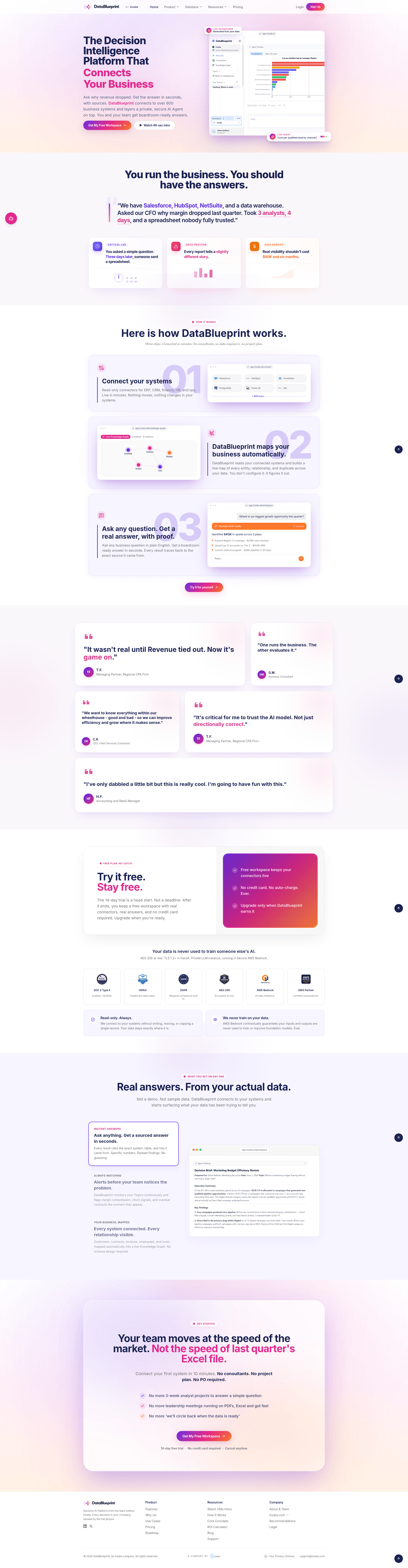
This is the cleanest category-definition angle because the page repeatedly emphasizes boardroom-ready answers, sourced results, and decision briefs rather than static BI. It differentiates from dashboard-first tools by focusing on questions and decisions.
The alternative to three-day spreadsheet investigations and conflicting executive reports.
The landing page makes the pain concrete: 3 analysts, 4 days, and a spreadsheet nobody trusts. That gives a strong before/after story against manual analysis and BI drift.
Your existing systems, connected read-only, mapped automatically, and monitored continuously.
This angle attacks implementation fear and IT friction. The page stresses no consultants, no data engineers, no project plan, read-only connectors, and automatic graph mapping, which is a strong operational buying trigger.
Primary user
CFO or finance leader at a mid-market company drowning in disconnected systems and ad hoc analysis requests
ICP #1
CFO at a 200-1,000 employee company with Salesforce, NetSuite, and a warehouse
Pain
Every board question turns into a multi-day analyst scramble across spreadsheets, and nobody fully trusts the final number.
Why this solves
DataBlueprint connects the systems, maps the entities automatically, and returns a sourced answer in seconds so the CFO can defend margin, revenue, and working-capital questions without waiting on BI backlog.
ICP #2
Revenue Operations Director at a B2B SaaS company
Pain
Pipeline, churn, and account expansion data live in separate tools, so leadership meetings rely on conflicting reports and gut feel.
Why this solves
The live knowledge graph and sourced Q&A unify CRM, finance, and warehouse data, making it easier to answer questions like where growth is coming from and which accounts are expansion candidates.
ICP #3
Managing Partner at a regional CPA or advisory firm
Pain
Client questions about profitability, margin variance, and operational performance require manual reconciliation before anyone will trust the answer.
Why this solves
The product is explicitly positioned around trustworthy, traceable answers and includes testimonials from a managing partner and consultants, which fits advisory workflows that require proof behind every number.
Strengths
- +The pain framing is sharp and believable: delayed answers, conflicting reports, and expensive visibility projects.
- +The product mechanics are unusually concrete for an AI homepage: 800+ connectors, auto-mapped knowledge graph, sourced answers, continuous monitoring.
- +Security/compliance is front and center, which matters for an enterprise trust sale.
Weaknesses
- −The homepage is overloaded with claims: decision AI, knowledge graph, AI agent, live dashboards, topic monitoring, boardroom-ready answers. It needs one primary story, not five.
- −"Leadership teams" is too vague as a target audience; it hides the strongest buyer and use case, which appears to be finance-led operational decision-making.
- −The product names of features are abstract and interchangeable; there is not enough proof of a killer workflow beyond the example question about growth opportunity.
- −The testimonials are helpful but thinly contextualized; we need more role-specific proof, business outcomes, and before/after metrics.
- −The landing page leans hard on trust and infrastructure, but does not clearly show how an end user gets from connected systems to an answer in under 10 minutes.
Fix these
- Choose a single wedge: lead with CFO/finance decision intelligence for companies with fragmented systems, then expand to CEO and RevOps.
- Replace broad AI language with 3-4 concrete use cases like margin drop analysis, churn risk detection, and contract overdues, each with an example output.
- Add a visual workflow showing exact inputs and outputs: connected systems -> knowledge graph -> sourced decision brief -> alert.
- Strengthen proof with named customer logos, quantified outcomes, and one or two full case studies showing time saved and decisions made.
- Tighten the hero copy around one core promise: "Ask a business question, get a sourced answer from all your systems in seconds."
Drop-in replacement copy
Headline
Ask business questions. Get evidence.
Connect live systems read-only and get sourced answers in seconds.
Answers you can defend
Ask a question in plain English and get a ranked answer with citations. Every response traces back to the exact system, table, and row, so leadership can trust the number.
Your company mapped automatically
DataBlueprint builds a live knowledge graph from your business systems without a manual modeling project. It detects entities, relationships, and duplicates so your data stops living in silos.
Alerts on the things that matter
Monitor margin compression, churn signals, overdue contracts, and other critical topics continuously. Get alerted before the problem shows up in a meeting.
Security built for serious buyers
Connect read-only to 800+ systems with a private LLM instance on AWS Bedrock. No training on customer data, with SOC 2 Type II, HIPAA, GDPR, AES-256, and TLS 1.2+ coverage.
FAQ
How is this different from Tableau or Power BI?
Those tools help you build dashboards. DataBlueprint helps you answer specific business questions with evidence and citations, without waiting for a report to be built.
Do you write back into our systems?
No. Connections are read-only. We are designed to query and monitor your live data without changing production records.
How fast can we get an answer?
Once connected, users can ask questions immediately and get sourced answers in seconds. The graph and monitoring layer continue learning from your connected systems over time.
What systems do you connect to?
We support 800+ business systems, including ERP, CRM, finance, HR, ops, Snowflake, PostgreSQL, Power BI, dbt, Salesforce, and HubSpot.
Is our data used to train the model?
No. We use a private LLM instance on AWS Bedrock and do not train on customer data.
You asked a simple question. Three days later, someone sent a spreadsheet. DataBlueprint connects your systems read-only, maps the entities, and returns a sourced answer in seconds. No analyst bottleneck. No trust gap.
CFOs don't need another dashboard. They need one answer they can defend. DataBlueprint turns live company data into sourced answers and alerts across finance, CRM, HR, and ops. Built for board questions, margin checks, and churn signals.
800+ connectors. Auto-built knowledge graph. Question in plain English. Then you get a ranked answer with citations down to the row. That's the product. Not slides. Not dashboards. Just answers.
We killed the dashboard-first idea. Leadership teams don't want 12 charts. They want to know why margin dropped, which contracts are overdue, and where growth is hiding. So we built DataBlueprint around questions, evidence, and alerts.
The trust test is simple: Can you point to the exact system, table, and row behind the answer? DataBlueprint does that by default. That is what makes it useful for CFOs, controllers, and advisory teams who hate hand-wavy AI.
By the time the spreadsheet lands in Slack, the numbers changed. Margin compression. Churn risk. Contract overdues. DataBlueprint watches the live data and alerts you when something matters.
Read-only access changes everything. Connect to 800+ systems, build the live graph automatically, and keep IT happy. No data warehouse project. No consultant army. No one touching production data.
Ask: why did margin drop? Get back a sourced brief that traces the answer across contracts, invoices, payroll, and cost data. That's the difference between guessing and leading.
Boardroom answers need receipts. That's why every answer in DataBlueprint comes with citations to the source system, table, and row. If the number matters, the proof should be right there.
We built this for the question nobody can answer fast enough: "What changed?" Not after a week. Not after a meeting. Right now, from the data you already have.
Angle: CFO pain: board questions become spreadsheet investigations
You asked a simple question. Three days later, finance sent a spreadsheet, ops sent a different number, and nobody wanted to defend either one. That is still how too many leadership teams work. We built DataBlueprint for the CFO who is tired of turning board questions into analyst projects. It connects to 800+ business systems read-only, builds a live knowledge graph of your company data, and answers questions in plain English with source citations down to the system, table, and row. So when someone asks: - Why did margin drop? - Which contracts are overdue? - Where is churn risk building? You get a sourced answer, not a dashboard hunt. The point is not more AI. The point is less waiting, less guessing, and fewer meetings spent reconciling numbers. If your team is still spending days assembling answers from disconnected systems, this is for you.
Angle: Decision intelligence vs dashboard-first BI
Most BI tools are built around a bad assumption: people want more charts. They don't. They want answers. A leadership team does not wake up wanting to browse Tableau or Power BI. They wake up needing to know what changed, why it changed, and what to do next. That is why we built DataBlueprint as decision intelligence, not dashboard software. It connects live company data, maps the entities automatically, and returns boardroom-ready answers with citations. No data engineer ticket. No manual model work. No waiting for someone to build the next report. If you're leading finance, rev ops, or a complex services business, the value is simple: ask the question, get the evidence, move faster. We think the future of executive analytics is not more dashboards. It is fewer steps between question and decision.
Angle: Trust, traceability, and why AI needs receipts
The biggest problem with AI in business is not speed. It is trust. If a model gives you a number and you cannot trace it back to the source, you cannot use it in a board meeting. That is why DataBlueprint was designed around traceability from day one. Every answer is sourced. Every answer includes citations. Every answer can be traced back to the exact system, table, and row. For CFOs, controllers, and advisory teams, that matters more than a flashy interface. You need to defend margin, revenue, working capital, and risk with evidence. We also keep the data read-only and run a private LLM instance on AWS Bedrock, with no training on customer data. The product is built for one job: turn live company data into answers people can actually trust.
No visuals for this kit yet.
Tagline
Sourced answers from your live company data
Description
Ask business questions in plain English and get cited answers from 800+ connected systems. DataBlueprint builds a live knowledge graph, monitors key topics, and helps leadership teams move from spreadsheet hunts to fast, defensible decisions.
Maker's first comment
We built DataBlueprint because we kept seeing the same pattern: someone in finance or ops asks a straightforward question, and it turns into a multi-day scramble across systems, spreadsheets, and half-trusted reports. The frustrating part was never the lack of data. It was the lack of a reliable way to connect the data, understand the relationships, and answer the question with proof. So we built a product that connects to 800+ business systems read-only, builds a live knowledge graph automatically, and returns sourced answers with citations down to the system, table, and row. We also added continuous alerts for things leadership teams actually care about, like margin compression, churn signals, and overdue contracts. This is especially for CFOs, finance leaders, rev ops teams, and advisory firms that need to defend numbers, not just visualize them. Would love feedback on the clarity of the wedge and which use case feels most urgent first.
Pinned maker comment
Would love feedback on the homepage wedge: CFO/finance first, or RevOps first? Also curious whether the sourced-answer workflow is clear enough in the first 10 seconds.
Meta
Targeting CFOs drowning in spreadsheet chaos
Hypothesis: mid-market CFOs will click if we promise a faster way to defend board numbers without waiting on analysts. DataBlueprint connects live systems read-only, maps the company automatically, and answers finance questions with citations.
Google Search
Ask finance questions. Get cited answers.
Hypothesis: people searching for financial reporting, margin analysis, or board reporting want an evidence-backed alternative to dashboards. DataBlueprint turns connected company data into sourced answers from CRM, ERP, warehouse, and ops systems.
Reddit Promoted
Built for teams tired of spreadsheet archaeology
Hypothesis: founders and operators in smaller SaaS/business communities will respond to a product that saves them from manual reconciliation and conflicting reports. DataBlueprint connects read-only to your systems and gives you answers with citations.
Subreddits
r/SideProject
Show the before/after workflow: disconnected systems -> live graph -> sourced answer. Keep it as a build story, not a product pitch.
Rules: No hard selling; share what you built, what broke, and what you learned.
r/indiehackers
Share the origin story of building an answer-first analytics product for finance and ops teams, with screenshots of the sourced-answer flow.
Rules: Be transparent, include numbers or lessons, and avoid obvious self-promo.
r/microsaas
Position it as a high-value niche SaaS for CFOs and operators, focusing on the narrow wedge and early customer discovery.
Rules: Show niche fit, shipping details, and go-to-market lessons.
r/EntrepreneurRideAlong
Share the journey from pain point to product, especially the repeated board-question scramble and the decision to build traceable answers.
Rules: Story-first posts do better than feature dumps; keep it honest and specific.
r/FinancialCareers
Frame it around reducing analyst busywork and helping finance teams defend numbers faster.
Rules: Stay relevant to finance professionals; avoid spammy startup language.
Communities
Post a build log, then reply to every comment with specifics about data connectors, sourcing, and the first customer conversations.
Share practical examples of how sourced answers help revenue teams reconcile pipeline, churn, and expansion data. Lead with a useful teardown, not a pitch.
Engage in discussions about forecast accuracy, board reporting, and operating cadence. Offer a live demo only after you have contributed useful commentary.
Cold outreach template
Hey {firstName} — noticed {context} and thought of DataBlueprint. We connect to your live systems read-only and answer finance/ops questions with citations, so you can stop chasing spreadsheets for board answers. If margin, churn, or contract visibility is still a manual scramble, worth a quick look?
Product Hunt timing
Launch on Tuesday at 12:01 AM Pacific Time. Tuesday gives you a full workweek of search traffic and follow-up, and a midnight PT launch catches the US morning while still overlapping Europe for early momentum. This fits CFO/RevOps buyers better than a weekend launch, since they discover tools during work hours.
Indie Hackers post ideas
- 01How we turned a 3-day spreadsheet hunt into a sourced answer in seconds
- 02Building a live knowledge graph for finance data: what actually worked
- 03Why we chose CFOs as the first wedge for our decision intelligence product
Competitor alternatives
Current tone of voice
Confident, executive-facing, and slightly provocative, with lines like "You asked a simple question. Three days later, someone sent a spreadsheet."
Your kit is ready. Sign up free to unlock, takes 10 seconds.
7 more X posts · 2 LinkedIn · Product Hunt copy · ad hooks · 100-user playbook · landing critique