
Cal.com
Open, customizable scheduling software for booking meetings and embedded appointment flows.
Tagline
Scheduling infrastructure, not just booking links
Open scheduling for products that need users booking users
The customizable Calendly alternative for teams that outgrew Calendly
Kill no-shows with scheduling you control end to end
The open scheduling layer for any product that needs users to book users.
This is the sharpest category-defining angle because the page repeatedly speaks to developers and embeds/API use cases, not just personal scheduling. It differentiates Cal.com from point-solution booking tools by framing it as infrastructure.
The more customizable alternative to Calendly for teams that have outgrown one-size-fits-all scheduling.
The testimonial copy directly references migration from Calendly, and the page highlights buffers, links, embeds, payments, reminders, and app integrations. That gives a clear competitor-comparison narrative.
Kill no-shows and scheduling friction with a booking flow you can control end to end.
The page showcases reminders, rescheduling, confirmations, time slots, buffers, and notice settings. That makes the core pain-killer message concrete: fewer missed meetings and less calendar chaos.
Primary user
Operations-minded professionals and founders who take a high volume of scheduled calls and need more control than Calendly gives them
ICP #1
Founder-led B2B SaaS team using meetings as part of the product workflow
Pain
They need scheduling to feel native inside their product instead of sending users to an external Calendly page, and they hate brittle integrations that break the UX
Why this solves
Cal.com explicitly markets a platform API, easy embeds, and customization, which makes it a fit for product-led teams that want booking to live inside their own app
ICP #2
Independent consultant or agency owner booking discovery calls, client calls, and paid sessions
Pain
They lose time managing back-and-forth scheduling, want fewer no-shows, and need a booking page that looks professional and is easy to remember
Why this solves
Cal.com offers custom booking links, reminders, buffers, payments through Stripe, and simple customization so the booking flow can drive revenue and reduce admin overhead
ICP #3
Privacy-conscious operations leader in healthcare, legal, or regulated services
Pain
They need scheduling that respects privacy expectations and cannot afford sloppy data handling or a consumer-grade experience
Why this solves
The page explicitly emphasizes privacy-first positioning and cites a customer from a health company saying PHI protection was non-negotiable, which makes this a credible angle for regulated teams
Strengths
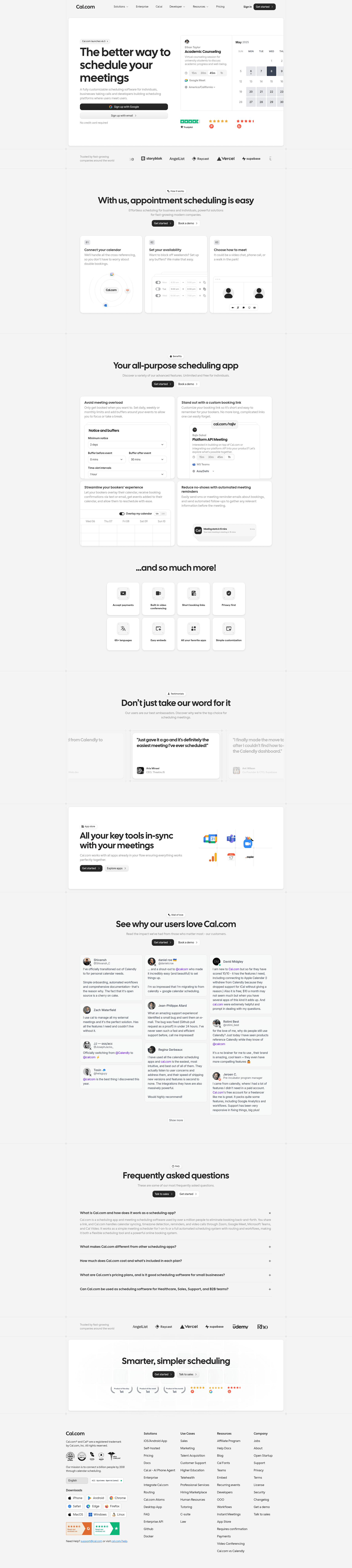
- +The page is unusually clear about who it is for: individuals, businesses taking calls, and developers building scheduling platforms.
- +It shows real product behavior, not abstract claims, with concrete features like buffers, minimum notice, reminders, embeds, and Stripe payments.
- +The social proof is strong and specific, including recognizable names like Guillermo Rauch, Kent C. Dodds, Ant Wilson, and a healthcare/privacy angle from Navi.
Weaknesses
- −The headline is generic and could be mistaken for any scheduling app; it does not immediately communicate open source, embeddable infrastructure, or developer-first differentiation.
- −The page feels repetitive and bloated, especially the repeated testimonial carousel, which dilutes the strongest proof points.
- −It tries to sell too many audiences at once: solo users, businesses, and developers are all on the same page without a clear hierarchy or tailored path.
- −Several feature claims are surfaced as flat lists instead of outcome-driven proof, so the page tells me what exists but not why it matters in practice.
- −The visuals are polished but not sufficiently explanatory for complex features like platform API, embeds, or privacy-first architecture.
Fix these
- Split the homepage into three explicit paths: individual scheduling, team scheduling, and developer/platform use cases, each with tailored proof and CTA.
- Replace generic scheduling copy with sharper differentiated messaging around open scheduling infrastructure, embeddability, and customization versus Calendly.
- Cut the testimonial repetition and instead feature 3-5 proof points that map directly to core use cases: migration from Calendly, privacy, developer adoption, and monetized bookings.
- Add a clearer product architecture section that explains exactly how calendars, embeds, reminders, Stripe, and Cal Video fit together.
- Show one or two concrete developer examples, such as 'embed Cal.com in your SaaS onboarding flow' or 'build a marketplace booking layer with the API,' to make the platform story real.
Drop-in replacement copy
Headline
Scheduling infrastructure for modern products
Embed booking flows, control availability, and keep users inside your app.
Keep booking inside your product
Embed scheduling where your users already are instead of sending them to a separate page. It makes the flow feel native and reduces drop-off.
Prevent messy calendar conflicts
Connect calendars, cross-check availability, and block bad slots before they become double bookings. Add buffers, minimum notice, and booking limits when the schedule gets serious.
Turn meetings into revenue
Take payments with Stripe for consults, sessions, or premium calls. Automate confirmations, reminders, and follow-ups so paid time doesn’t turn into admin work.
Build on a flexible scheduling layer
Use custom links, multiple meeting types, Cal Video, and a platform API for product workflows. It works for solo founders, teams, and developers shipping user-to-user booking.
FAQ
How is this different from Calendly?
Calendly is great for simple booking links. Cal.com is built for teams and products that need more customization, embeds, API access, and workflow control.
Can I embed Cal.com in my app?
Yes. Embeds are a core part of the product, so you can keep the booking flow inside your SaaS, marketplace, or onboarding experience.
Can I charge for bookings?
Yes. You can connect Stripe and take payment before or during the booking flow, which is useful for consultants, agencies, and paid sessions.
Does it handle reminders and rescheduling?
Yes. Confirmation messages, calendar adds, reminders, and follow-ups are built in, along with rescheduling support.
Is this only for developers?
No. It works for solo professionals and operators too, but the product is especially useful if you need scheduling to fit into a larger workflow.
Calendly is fine until scheduling is part of your product. Cal.com is open scheduling infrastructure: embeds, API, custom links, reminders, Stripe, video. If users need to book users inside your app, this is the layer.
Stop sending users away to book. Embed scheduling directly into your SaaS, marketplace, or onboarding flow. Cal.com gives you calendars, availability rules, payments, reminders, and a real API.
We built scheduling like infrastructure. Not a pretty booking page. A system for calendars, embeds, payments, reminders, and custom workflows that can live inside any product.
Most scheduling tools stop at a link. Real scheduling has buffers, minimum notice, weekend rules, SMS reminders, rescheduling, payments, and video. That’s the part we obsessed over.
Your calendar should not double-book. Or force you to manually babysit availability. Cal.com cross-checks calendars, blocks bad slots, and handles the annoying parts before they become a mess.
No-shows are a systems problem. Fix them with reminders, calendar adds, minimum notice, buffers, and follow-ups. That’s what scheduling software should do.
Watch a booking flow disappear. Open a link, choose a slot, pay if needed, get confirmed, synced, and reminded. No back-and-forth. No manual coordination. Just booked.
Built for embeds, not screenshots. Put scheduling inside your app, then customize the flow for your users. That’s the difference between a tool and a platform layer.
Founders keep migrating from Calendly. Same reason every time: more control, better embeds, real customization, and less awkward scheduling glue. If your workflow is growing up, your scheduler should too.
Teams with privacy needs use this. Healthcare, legal, and regulated services need scheduling that doesn’t feel consumer-grade. Cal.com is built for that bar.
Angle: Developer-first scheduling infrastructure
Most scheduling products are built for one person booking one meeting. That works until scheduling becomes part of the product. If your users need to book other users inside your SaaS, marketplace, or internal workflow, sending them to a separate booking page is a broken experience. That’s why we built Cal.com as scheduling infrastructure, not just a scheduler. You can: - embed booking flows inside your product - connect calendars and prevent double bookings - set buffers, minimum notice, and availability rules - take payments with Stripe - use video, reminders, and follow-ups - customize the experience instead of fighting it The point is not to create another link. The point is to make scheduling feel native. If you’ve ever duct-taped Calendly into a product flow and hated the result, this is probably the category you wanted all along.
Angle: Calendly alternative for operators and consultants
The real cost of bad scheduling is not just time. It’s the back-and-forth. It’s the missed calls. It’s the awkward reschedules. It’s the admin work that piles up when your calendar gets busy enough to matter. For consultants, agencies, recruiters, and founders, scheduling is part of the business model. So we built Cal.com to handle the parts that actually hurt: - custom booking links - reminders and follow-ups - rescheduling flows - buffers and minimum notice - paid bookings through Stripe - multiple meeting types The goal is simple: fewer no-shows, less coordination, and a booking page that doesn’t feel generic. A scheduler should earn its place in your workflow. Not just exist beside it.
Angle: Privacy and control for regulated teams
Some teams don’t need a prettier scheduling page. They need control. If you work in healthcare, legal, or any regulated environment, booking software is not a throwaway tool. It touches sensitive data, user trust, and operational risk. We kept hearing the same thing from teams in these spaces: the booking flow has to feel clean, private, and intentional. That’s the lens we used for Cal.com. Cross-calendar availability checks. Customization that fits the workflow. Booking pages that can be embedded where you already work. Automation that reduces manual handling. The lesson is pretty simple: when scheduling is part of a serious business, the scheduling stack should be serious too. Curious how other teams are handling this. Would love to hear what matters most: privacy, customization, or workflow fit.
No visuals for this kit yet.
Tagline
Open scheduling infrastructure for any product
Description
Cal.com is customizable scheduling software for teams, founders, and developers. Embed booking flows, connect calendars, take payments, automate reminders, and keep scheduling inside your product.
Maker's first comment
We built Cal.com because scheduling kept showing up as a hidden product surface. At first, it looks simple: pick a time, send a link, move on. But once you’re running a real business or shipping a product with user-to-user booking, scheduling becomes infrastructure. It needs to handle availability, rescheduling, reminders, payments, embeds, privacy, and enough flexibility to fit different workflows without making users jump to another app. That’s the problem we kept running into ourselves, and it’s the problem we kept hearing from founders, agencies, consultants, and teams in regulated industries. We wanted something that felt native, customizable, and actually usable beyond the first demo. So we built Cal.com to be the scheduling layer you can shape around your product instead of forcing your product around a booking link. If you try it, I’d love feedback on two things: where it feels most natural in your workflow, and where it still feels too opinionated or too complex. We’re especially interested in how teams use embeds and the API in real products.
Pinned maker comment
Would love feedback on the developer experience, embed flow, and where the product still feels too generic for real workflows.
Meta
Users keep leaving your app to book.
Hypothesis: SaaS founders and product teams will convert if booking can live inside the product instead of sending users to a separate scheduler. Cal.com lets you embed booking flows, connect calendars, set availability rules, take payments, and automate reminders.
Google Search
Calendly alternative with embeds and API
Hypothesis: people searching for a Calendly alternative want more control, not just a prettier booking page. Cal.com adds embeds, custom links, Stripe payments, reminders, and developer-friendly scheduling infrastructure.
Reddit Promoted
Built a booking flow your users never see leave.
Hypothesis: founders and indie hackers in product-heavy communities care more about native UX than standalone scheduling pages. Cal.com helps you embed scheduling, manage availability, and automate reminders without duct-taping together tools.
Subreddits
r/SideProject
Show the product as infrastructure for embedding scheduling inside a SaaS workflow, with a short demo and a lesson learned from building it.
Rules: Share the build story and what you learned; avoid hard selling and title it like a project update, not an ad.
r/indiehackers
Write about replacing Calendly-style links with embedded scheduling inside product flows and the conversion/UX lesson behind it.
Rules: Must be founder-relevant and educational; community prefers process, numbers, and honest context over promo.
r/microsaas
Talk about how micro-SaaS operators can monetize calls, reduce no-shows, and automate scheduling without custom engineering.
Rules: Stay practical, show the workflow, and avoid posting purely promotional copy.
r/EntrepreneurRideAlong
Share a real founder problem: managing discovery calls, client bookings, and paid sessions with less admin overhead.
Rules: The sub likes transparent updates and journey posts; keep it narrative and concrete.
r/SaaS
Frame it as a scheduling layer for SaaS products that need users booking users, with examples of embeds and APIs.
Rules: Use a useful angle or case study; no obvious spam, and be ready to answer implementation questions.
Communities
Post one build story, one customer/problem breakdown, and one tactical lesson about embeds or conversion. Comment on other founders' scheduling, onboarding, and marketplace threads before posting.
Launch with a technical angle: open scheduling infrastructure, embeddable flows, and API-first design. Keep the submission title factual, and be active in comments with specifics.
Engage around product workflows, onboarding friction, and reducing operational overhead. Share a real example of how embedded scheduling improves conversion or activation.
Cold outreach template
Hey {firstName} — saw {context} and thought of you because a lot of teams end up duct-taping scheduling into a product or sales flow. We built Cal.com so booking can live inside the app, with embeds, calendar sync, reminders, and Stripe if you need paid sessions. If you’re open to it, I’d love to show you the 2-minute version and get your honest take.
Product Hunt timing
Launch on Tuesday at 12:01 AM Pacific Time. That gives you a full U.S. business day, catches West Coast makers early, and still lands cleanly for Europe in the morning; it also fits the ICP because founders and builders are most active on weekdays, not weekends.
Indie Hackers post ideas
- 01We replaced a generic booking page with embedded scheduling inside the product
- 02What actually reduced no-shows for our clients: buffers, notice windows, and reminders
- 03Why scheduling needed to become infrastructure, not just a link
Competitor alternatives
Current tone of voice
Confident, modern, and lightly playful with developer credibility. Example: 'The better way to schedule your meetings' and 'It could be a video chat, phone call, or a walk in the park!'
Your kit is ready. Sign up free to unlock, takes 10 seconds.
7 more X posts · 2 LinkedIn · Product Hunt copy · ad hooks · 100-user playbook · landing critique