
Lighthouse
Waitlists, surveys, newsletters, and feedback in one tool for indie founders.
Tagline
Validate before you build. Keep users after launch.
Evidence first. Vibes later.
Stop stitching five tools together.
Turn waitlists into buyers, not dead lists.
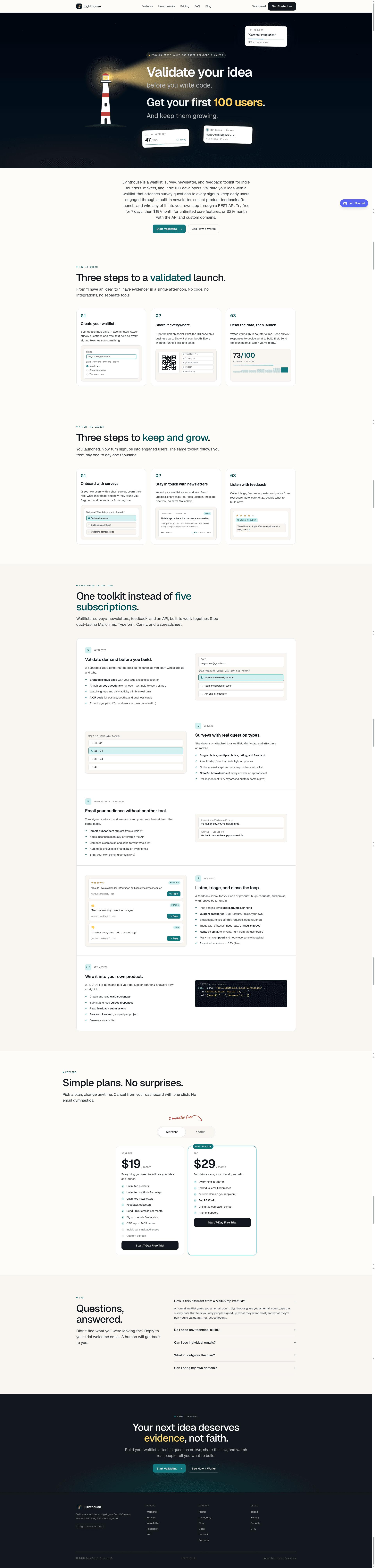
The pre-launch operating system for indie founders who need evidence, not vibes.
The product is explicitly built around validation: waitlists with attached questions, real-time signup tracking, and surveys that reveal what users want most.
The lightweight alternative to Mailchimp + Typeform + Canny for early-stage products.
The page directly names those tools as the fragmented stack Lighthouse replaces, and the feature set mirrors the exact early-stage jobs those products would be used for.
Turn your waitlist into a revenue-ready audience, not a dead email list.
Lighthouse doesn't stop at collecting signups; it includes newsletters, feedback, and API hooks so the same audience can be nurtured and activated after launch.
Primary user
Indie SaaS founder validating a new product idea before or right after writing code
ICP #1
Solo founder building a new B2B SaaS from scratch
Pain
They have a landing page and a waitlist, but the signup count is useless without knowing what people actually want or what they would pay for.
Why this solves
Lighthouse attaches survey questions directly to each signup, so the founder can learn priorities, segment interest, and decide what to build first instead of guessing from a raw email count.
ICP #2
Indie iOS developer pre-launching a consumer app
Pain
They need to collect prelaunch interest from multiple channels and then keep those users warm after App Store launch without buying separate email and feedback tools.
Why this solves
Lighthouse combines waitlists, newsletters, and feedback in one workflow, plus QR codes and API access for capturing users from events, social posts, and in-app onboarding.
ICP #3
Bootstrapped maker replacing a messy stack of lightweight SaaS tools
Pain
They are duct-taping Mailchimp, Typeform, Canny, and spreadsheets together and wasting time exporting/importing the same audience data.
Why this solves
Lighthouse centralizes signup capture, surveys, campaigns, and feedback into one dashboard, with CSV export and a REST API to keep data in sync.
Strengths
- +The value prop is brutally clear: validate before you build, then keep the same audience after launch.
- +The product is demonstrated with concrete UI examples like "Cal AI waitlist" and "Calendar integration" responses, which makes the workflow feel real.
- +Pricing is simple and founder-friendly, with a 7-day trial and a clear upgrade path from no-code to API access.
Weaknesses
- −The homepage tries to sell four products at once, which dilutes the core message and may confuse buyers who only need a waitlist or only need feedback.
- −There is too much feature inventory and not enough proof: no testimonials, no case studies, no hard numbers beyond illustrative counters.
- −The page leans heavily on the indie-founder persona and may undersell adjacent audiences like product managers at tiny startups or agencies validating client ideas.
- −The differentiation versus cheaper tools is implied, not proven; the page says "replace Mailchimp, Typeform, Canny" but doesn't show why Lighthouse is better beyond convenience.
- −The API is mentioned, but the use cases are thin, so technical buyers may not immediately see why they'd choose it.
Fix these
- Make the homepage choose one primary wedge: "waitlist + survey validation" should lead, with newsletter and feedback framed as post-launch expansions.
- Add a strong proof section with real customer examples, before/after metrics, or screenshots showing how survey data changed what was built.
- Create separate landing pages for each use case: waitlist validation, newsletter campaigns, feedback inbox, and API.
- Show concrete comparison tables against Mailchimp, Typeform, Canny, and Carrd/Google Forms so the substitution story feels real.
- Add more specificity around integrations and API workflows, especially for indie iOS and SaaS builders who want data to flow into their own app.
Drop-in replacement copy
Headline
Validate before you build.
Waitlists, surveys, newsletters, and feedback for indie founders.
Learn what people want at signup
Every waitlist signup can include survey questions, so you get context instead of a useless email count. Use the answers to decide what to build first.
Keep your audience in one place
Collect signups, send newsletters, and gather feedback without moving people across multiple tools. Your early users stay in one workflow from pre-launch to post-launch.
Capture interest from anywhere
Share a branded waitlist page, generate QR codes for events, or connect Lighthouse through the REST API. It works for X, Reddit, meetups, and inside your app.
See what matters in real time
Track signups, responses, and feedback as they happen. Use statuses, ratings, categories, and exports to stay organized without touching a spreadsheet.
FAQ
Is Lighthouse just for waitlists?
No. Waitlists are the wedge, but Lighthouse also handles surveys, newsletters, feedback, and API access so you can keep using the same audience after launch.
How is this different from Mailchimp or Typeform?
Mailchimp is for email campaigns and Typeform is for forms. Lighthouse combines signup capture, question collection, follow-up, and feedback in one place for early-stage products.
Can I use it for an app launch or event?
Yes. You can use QR codes, branded pages, and the API to capture interest from meetups, social posts, App Store prelaunch pages, or inside your app.
Do I need to know how to code?
No. You can start with the hosted waitlist and surveys. If you want deeper integration later, the REST API and custom domain support are there on Pro.
What happens after people join the waitlist?
You can email them, collect feedback, categorize requests, and segment by their survey answers. The point is to turn interest into a usable audience, not let it sit in a list.
Most waitlists are just dead email lists. Lighthouse turns every signup into signal: • ask survey questions on signup • track what people actually want • send newsletters + collect feedback after launch Built for indie founders who want evidence, not vibes.
I built one tool instead of four. Lighthouse replaces the usual early-stage mess: Mailchimp + Typeform + Canny + spreadsheets. Waitlist pages, surveys, newsletters, feedback, API. If you're validating a SaaS idea, this is the stack I wish I had first.
The real problem isn't signups. It's getting a signup and still not knowing: - what they want - why they joined - what to build first Lighthouse attaches questions to the waitlist so every email comes with context.
I kept seeing founders guess. Guess what feature matters. Guess who is serious. Guess what to build next. So I made Lighthouse: a waitlist + survey + feedback tool for founders who want the answer before they write code.
Five tools for one audience is stupid. You don't need: Mailchimp for email Typeform for questions Canny for feedback Sheets for exports Another dashboard for analytics You need one place to capture, learn, and follow up.
A waitlist without questions is useless. 100 signups tells you nothing. 100 signups with survey answers tells you what to build, who wants it, and what they'll pay for. That is the whole point of Lighthouse.
Watch a waitlist turn into data: 1. create a branded page 2. add survey questions 3. collect signups from X, Reddit, QR, or your app 4. segment by answers 5. email them after launch That's Lighthouse.
QR code at a meetup becomes leads. That's one of the nicer parts of Lighthouse: - branded waitlist page - QR code for events - questions on signup - real-time counters Great for indie apps, meetups, demos, and anyone doing offline capture.
Founders don't need more dashboards. They need one place where the waitlist, feedback, and emails live together. That's why Lighthouse exists: less tool hopping, less exporting, less guessing.
The best validation tool is feedback. Not vanity signup counts. Not a pretty landing page. Real answers from real people at signup time, then a way to keep talking after launch. That's the workflow Lighthouse was built for.
Angle: Validation-first positioning
Most founders validate ideas backwards. They build a landing page, collect emails, and then stare at a number like it means something. It doesn’t. A waitlist is only useful if it tells you what people want, what they’d pay for, and what to build first. That’s why I built Lighthouse. It lets you: • create a branded waitlist in minutes • attach survey questions to every signup • segment early users by intent • keep the same audience warm after launch with newsletters and feedback So instead of guessing from raw email counts, you get actual signal. This is for indie founders, solo builders, and tiny teams shipping before they have the luxury of wasting time. If you're pre-launch, the goal isn't more traffic. It's better decisions.
Angle: Tool consolidation for bootstrapped builders
Bootstrapped founders have a special talent: we turn one simple workflow into a mess of subscriptions. Mailchimp for email. Typeform for questions. Canny for feedback. Spreadsheets for everything else. Then we spend evenings copying data between tools like human glue. Lighthouse is my attempt to cut that out. One place for waitlists. One place for surveys. One place for newsletters. One place for feedback. One REST API if you want the data inside your own app. The point isn’t to pack in features. The point is to remove the early-stage stack tax. If you’re validating an idea, launching a side project, or managing a tiny audience, the simplest tool is usually the one you actually keep using.
Angle: Post-launch audience retention
A lot of products are good at collecting interest. Very few are good at staying useful after launch. That’s a problem. Because the same people who joined your waitlist are usually your first customers, first testers, and first source of feedback. Lighthouse is built to keep that audience in one place. You can: • launch a waitlist • ask questions on signup • send campaigns later • collect feature requests and bug reports • track status and reply by email That means the audience you worked hard to earn doesn’t get abandoned in a spreadsheet the day you ship. If you’re building for indie SaaS, that continuity matters more than another pretty landing page.
No visuals for this kit yet.
Tagline
Waitlists, surveys, newsletters, and feedback in one tool
Description
Lighthouse helps indie founders validate ideas before building, then keep the same audience after launch. Create branded waitlists, attach questions to signups, send newsletters, collect feedback, and pipe everything into your app with an API.
Maker's first comment
I kept seeing the same pattern over and over: founders would launch a waitlist, get a few hundred signups, and still have no idea what those people actually wanted. The email count looked nice, but it didn’t help with the hard part — deciding what to build first. Lighthouse started as a fix for that problem. I wanted one place where a founder could capture interest, ask a couple of useful questions at signup, then keep talking to that audience after launch without duct-taping together Mailchimp, Typeform, Canny, and a spreadsheet. This is very much built for indie founders and small teams shipping before they have a big stack or a dedicated ops person. If you’ve ever wished your waitlist could tell you something useful instead of just collecting names, that’s the product. Would love feedback on the onboarding flow, the waitlist → survey workflow, and whether the API is clear enough for technical users.
Pinned maker comment
I’d especially love feedback on the core wedge: does “waitlist + attached questions” feel like the strongest entry point, or should I lead harder with newsletters/feedback/API?
Meta
Waitlists are useless without context.
Targeting indie SaaS founders validating a new idea. Hypothesis: founders will convert better if they can ask a question at signup instead of collecting empty emails. Lighthouse turns every waitlist signup into usable signal.
Google Search
Replace Typeform and Mailchimp
Targeting founders searching for waitlist, survey, and early-user tools. Hypothesis: people comparing fragmented tools want one simple stack for validation, newsletters, and feedback. Lighthouse combines all three, plus a REST API.
Reddit Promoted
Built a waitlist. Still guessing?
Targeting indie makers posting in startup communities. Hypothesis: early builders care more about learning what users want than collecting raw signups. Lighthouse adds survey questions, feedback, and follow-up in one place.
Subreddits
r/SideProject
Show the product as a response to the common side project problem: getting signups without knowing what to build next
Rules: Share what you built, what you learned, and what’s next. Avoid pure promo; include screenshots and a short build story.
r/indiehackers
Position as a validation stack for indie founders and ask for feedback on the waitlist-to-survey workflow
Rules: Be transparent, include numbers or learnings, and frame it as a discussion rather than an ad.
r/microsaas
Focus on replacing the messy early-stage stack with one tool for validation and audience management
Rules: Self-promo is limited; lead with the problem, show the workflow, and ask for criticism.
r/EntrepreneurRideAlong
Share the journey of building a tool for pre-launch founders and what traction tactics you’re testing
Rules: Must be a journey/update post, not a hard sell. People there prefer progress and lessons over product links.
r/startups
Talk about the pre-launch decision problem: how founders know what to build first from early user data
Rules: Higher scrutiny on promo; make it educational and share a useful framework or lesson.
Communities
Publish build logs, share the product decisions, and comment on other founders’ validation threads before posting your own launch story.
Post tiny daily progress updates and recruit users from people already shipping products, without pushing a sales pitch.
Use it as a transparent build-in-public channel: show usage, user feedback, and what changed in the product.
Cold outreach template
Hey {firstName} — saw {context} and thought you might care about this. I built Lighthouse for founders who want to attach questions to waitlist signups instead of collecting empty emails. If you’re validating a new idea, I’d love to give you access and hear what’s missing.
Product Hunt timing
Launch on Tuesday at 12:01 AM Pacific Time. Tuesday gives you a full weekday runway without getting buried in weekend noise, and PT is best for hitting both US morning traffic and Europe’s afternoon overlap for indie founders.
Indie Hackers post ideas
- 01I stopped treating waitlists like vanity metrics — here’s the workflow that actually helps me decide what to build
- 02How I replaced Mailchimp + Typeform + Canny for an early-stage product
- 03What 100 waitlist signups taught me about building for indie founders
Competitor alternatives
Current tone of voice
Direct, indie-founder-friendly, and slightly punchy; examples include "Validate your idea before you write code" and "Stop stitching five tools together."
Your kit is ready. Sign up free to unlock, takes 10 seconds.
7 more X posts · 2 LinkedIn · Product Hunt copy · ad hooks · 100-user playbook · landing critique