
Blogr
Paste your site URL and get an SEO blog post tailored to it in seconds.
Tagline
Turn any URL into SEO content
Paste your site. Get the brief and draft.
Your site is the prompt.
Start with your website, not a blank page.
The fastest way to turn your website into a blog post brief and first draft.
The strongest differentiator is not just writing; it's the URL scan that extracts tone, audience, topics, and keywords automatically before generation.
An alternative to hiring a content writer for your first SEO posts.
For bootstrapped teams, the value is replacing early-stage outsourcing and reducing the friction of briefing a writer, especially when the site already contains the necessary context.
A blog post generator that starts with your site, not a generic prompt.
Most AI writing tools begin with empty prompts. Blogr's site analysis and pre-filled settings create a more grounded workflow, which is a strong pain-killer for founders sick of generic AI copy.
Primary user
Solo founders and indie SaaS operators who need SEO content but don't have a content team
ICP #1
Bootstrapped SaaS founder with a new product and zero marketing headcount
Pain
They know they need blog content for organic search, but they don't have time to create briefs, pick keywords, or write posts from scratch.
Why this solves
Blogr removes the blank-page problem by scanning the site, inferring the niche, and producing a ready-to-publish post plus SEO inputs in one flow.
ICP #2
Technical founder running a Next.js or developer-tool website
Pain
They can explain the product well, but content planning is a distraction and every article takes too long to structure and optimize.
Why this solves
The product pre-fills site description, audience, topics, and keywords from the URL, which fits a technical site where the founder wants speed and control over output.
ICP #3
Freelance SEO consultant working for early-stage startups
Pain
They need to produce first-draft blog content quickly across multiple client sites while keeping tone and topical focus aligned with each brand.
Why this solves
Blogr’s customizable settings, long-tail keyword targeting, and topic exclusions make it useful as a fast draft engine for small-scale content operations.
Strengths
- +The core promise is immediately understandable: paste URL, get a blog post, no account required.
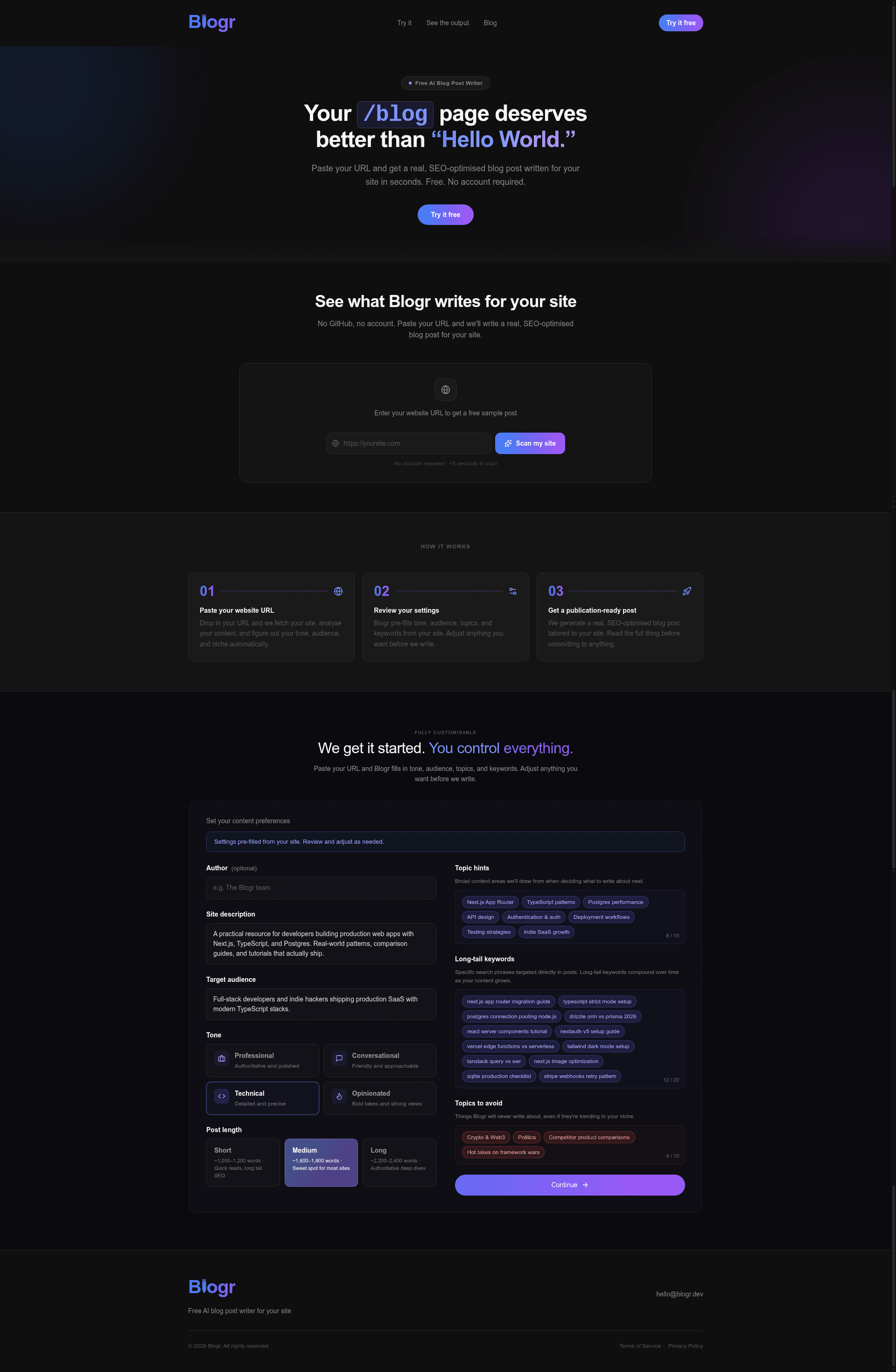
- +The product demo is concrete, showing actual fields like author, site description, audience, tone, and keywords instead of vague AI claims.
- +The page does a good job signaling SEO usefulness with specifics like long-tail keywords, topic hints, and post-length options.
Weaknesses
- −The brand name is inconsistent in the page copy as both 'Blogr' and 'Bogr,' which makes it look unfinished and hurts trust.
- −The homepage leans heavily on a form UI screenshot/explanation but doesn’t show a real generated output sample on the page itself.
- −There is no proof of quality: no examples, testimonials, search rankings, or before/after comparisons.
- −The value proposition is still generic at the top of the funnel; it doesn't explain why this beats ChatGPT plus a prompt, which is the obvious alternative.
- −The product is positioned as 'free' and 'no account required' without explaining the business model or limits, which can create hesitation.
Fix these
- Add a visible real output sample with headline, structure, internal linking suggestions, and SEO metadata so visitors can judge quality instantly.
- Fix the brand inconsistency everywhere and make the product name visually dominant to avoid the 'typo prototype' feel.
- Add a direct comparison section: Blogr vs ChatGPT, Jasper, and hiring a freelancer, focusing on site-scanning and prefilled settings.
- Show one or two niche-specific examples, such as a Next.js dev blog or a SaaS landing page, to prove the URL-based workflow actually adapts to different sites.
- Introduce trust signals like usage stats, publishing examples, or a short explanation of how site data is used and what is not stored.
Drop-in replacement copy
Headline
Turn your site into a blog post
Paste a URL. Get a site-aware SEO draft in seconds.
Start with your actual website
Blogr scans your URL and pulls in the context your blog post needs before it writes a word. That means less prompt juggling and fewer generic outputs.
Skip the brief-writing chore
Tone, audience, site description, topic hints, and keywords are prefilled for you. You can edit everything before generation if you want more control.
Write for search, not just for vibes
Use long-tail keywords, topic hints, and topics-to-avoid to steer the draft toward real SEO value. It’s built for posts people can actually find.
No account, no friction
Try it instantly without creating an account. Free access makes it easy to test on your site before deciding if it fits your workflow.
FAQ
How is this different from ChatGPT?
ChatGPT starts with a blank prompt. Blogr starts with your website, scans it for context, and pre-fills the setup so the output is grounded in your actual product.
Do I need to create an account?
No. You can paste a URL and try it right away.
Can I change the tone and keywords before it writes?
Yes. The settings are editable before generation, so you can keep control over the final draft.
Who is this for?
It’s for solo founders, bootstrapped SaaS teams, developer-founders, and freelance marketers who need SEO content without a full content process.
Does it work for any website?
It works best on product, SaaS, agency, and creator sites with enough copy for the scanner to infer tone, audience, and topics.
You don’t need another AI writer. You need a way to turn your website into a blog post. Blogr scans your URL, pulls tone + audience + keywords, and writes the first draft. Free. No account required. blogr.ai
Most AI tools start with a prompt. Blogr starts with your site. Paste your URL → it detects tone, audience, topics, long-tail keywords → you tweak settings → it writes the post. For founders who hate briefs.
Your blog page deserves better than “Hello World.” Blogr turns a website URL into an SEO blog post in seconds. No account. No prompt engineering. No staring at a blank doc. If you’re a founder, try it.
I kept seeing founders ask ChatGPT to write blog posts and getting generic sludge back. So I built Blogr: paste a URL, scan the site, auto-fill the brief, then generate the draft. It’s for people who want output, not prompt wrestling.
What users keep liking about Blogr isn’t just the draft. It’s that the site scan fills in tone, audience, topics, and SEO keywords before writing starts. That means less editing, less guessing, and fewer “this sounds like AI” moments.
If you’re bootstrapped, the first blog posts are painful: brief a writer, explain the product, pick keywords, wait a week. Blogr cuts that down to one URL and one review screen. Fast enough to actually ship.
Blogr looks at your site first, then generates the post around what your product actually does. Tone, audience, topic hints, long-tail keywords, topics to avoid. Basically: a blog brief + first draft from one URL.
Built Blogr for solo founders and small teams who need SEO content but not a whole marketing department. Paste site URL. Review the prefilled settings. Generate the post. That’s the workflow.
Most tools start with a blank prompt and call it a product. Blogr starts with your website. That one change makes the output way less generic. I’m shipping this for founders who need first drafts, not content theater.
Founders don’t want “content tools.” They want the post written. Blogr gives them a URL-based brief, keyword ideas, and a ready-to-edit draft in one flow. No account. No setup. Just publish.
Angle: why starting from the URL beats prompting
I kept watching founders do the same annoying ritual: 1. Open ChatGPT 2. Paste a messy prompt 3. Explain their product for the third time 4. Get generic blog sludge back So I built Blogr. The idea is simple: paste your website URL and let the product do the context gathering first. Blogr scans the site and pre-fills the stuff people usually spend 20 minutes writing by hand: - tone - audience - site description - topic hints - long-tail keywords - topics to avoid Then you review it and generate the post. That matters because the hard part of SEO content is rarely the writing itself. It’s the blank page, the brief, and the “what should this post even be about?” problem. For solo founders and small marketing teams, that’s the real bottleneck. Not typing. Deciding. If your site already explains what you do, the tool should use that. That’s the whole product. Free. No account required. Try it if you want to turn your site into a post without starting from zero.
Angle: built for bootstrapped teams with no content headcount
The first SEO posts for a startup are weirdly expensive. Not because the words are hard. Because the process is annoying: - figure out the topic - pick keywords - write a brief - match the brand voice - keep it from sounding like AI - do it again next week That’s a lot if you’re a founder wearing every hat. Blogr is my attempt to remove that friction. You paste your URL. It scans the site and fills in the setup for you. You can change the tone, audience, post length, author, keywords, and topics to avoid before generating. So instead of “I should really start blogging,” you get to “this is publishable.” That’s the point. Not more content chaos. Less of it. If you’re bootstrapped and trying to get search traffic without hiring a writer, I’d love feedback from you. What would make this actually useful in your workflow?
Angle: positioning against ChatGPT and generic AI writers
I don’t think founders need another AI writer. They need a better starting point. ChatGPT is fine if you already know: - the angle - the audience - the keywords - the structure - the tone Most people don’t. Blogr starts with your website instead. That means the tool can infer context before generating anything. It’s a different workflow: URL in → site scan → prefilled brief → SEO blog draft out I built it because “just prompt better” is not a product strategy. And because most founders would rather ship a useful post than argue with an empty textbox. If you run a SaaS, dev tool, or agency site, I’m curious: would you rather start from a blank prompt, or from the site itself?
No visuals for this kit yet.
Tagline
Paste your URL. Get a blog draft.
Description
Blogr scans your site from a pasted URL, auto-fills tone, audience, topics, and keywords, then writes an SEO blog post you can edit before publishing. Free and no account required.
Maker's first comment
I built Blogr because I kept seeing the same failure mode with founders and small teams: they know they need content, but the first step is always the hardest one. You open a blank doc, try to explain the product, guess at keywords, and end up spending more time on setup than on publishing. Blogr starts from the website itself. Paste a URL, let it scan the site, and it pre-fills the content setup with tone, audience, site description, topic hints, long-tail keywords, and topics to avoid. Then it generates a draft you can review and change before anything gets written. I made it for solo founders, technical founders, and small marketing teams who want SEO content without turning it into a full-time project. If you try it, I’d love feedback on one thing in particular: does the site scan feel accurate enough to trust, or does it still need too much manual correction?
Pinned maker comment
Looking for feedback on the site scan quality, the usefulness of the prefilled settings, and whether the output feels more grounded than a typical ChatGPT prompt.
Meta
Founders, stop writing blog briefs by hand.
Hypothesis: solo founders and bootstrapped SaaS teams will convert better when the product starts from their URL instead of a generic prompt. Paste your site, auto-fill the brief, generate the post, publish faster.
Google Search
AI blog post generator for your website
Hypothesis: people searching for AI writing tools want something grounded in their own site, not another blank prompt. Blogr scans your URL, infers tone and keywords, and drafts SEO content in seconds.
Reddit Promoted
Built a tool that writes from your site, not a prompt.
Hypothesis: indie founders in r/SideProject and r/indiehackers are more interested in workflow tools than generic AI writers. Blogr scans a website URL, pre-fills the blog setup, and generates a first draft without an account.
Subreddits
r/indiehackers
Show the problem/solution: turning a site into a post brief, then ask founders if they’d use it for their own SaaS blog.
Rules: No pure self-promo; share what you built, why, and what you learned. Keep it useful and transparent.
r/SideProject
Post a build log with screenshots of the URL scan and generated output sample.
Rules: Must be a real side project, include process and results, not just a link drop.
r/microsaas
Frame it as a tool for bootstrapped founders who need their first SEO posts without hiring writers.
Rules: Focus on bootstrapped SaaS lessons and product details; avoid spammy marketing language.
r/EntrepreneurRideAlong
Share the journey of replacing the blank-page problem with URL-based generation and invite feedback from early founders.
Rules: Posts should be educational and personal, not just promotional.
r/SaaS
Discuss the broader content bottleneck for tiny SaaS teams and show how Blogr reduces setup time.
Rules: Be value-first; self-promo is often removed unless clearly useful and disclosed.
Communities
Write one build-in-public post per week: what you learned from the URL scan, what users changed, and one screenshot. Comment thoughtfully on other founders' growth and marketing threads before dropping your own link.
Build in Public Discord
Share short clips of the workflow, ask for brutal feedback on output quality, and offer to scan members’ sites live so you create reciprocity.
SaaS Growth Hacks Slack
Join conversations about SEO, content ops, and founder marketing. Post a case study, not a pitch: before/after time saved, plus the kind of site it works best on.
Cold outreach template
Hey {firstName} — saw {context} and thought of Blogr. It scans your site from a URL, pre-fills the blog brief, and writes the first draft without making you start from a blank prompt. If you want, I can run your site through it and send the result.
Product Hunt timing
Launch on Tuesday at 12:01 AM PT. That gives you a full weekday of momentum, catches US and EU builders awake, and fits the ICP because founders and marketers tend to browse PH early in the workweek when they’re planning tools to fix immediate bottlenecks.
Indie Hackers post ideas
- 01I replaced the blank-page problem with a URL scan
- 02What happened when I let a tool infer tone, audience, and keywords from a SaaS site
- 03Why I think founders need fewer AI writers and better starting points
Competitor alternatives
Current tone of voice
Playful, direct, and founder-friendly, with lines like "Your/blogpage deserves better than ‘Hello World.’" and "Free. No account required."
Your kit is ready. Sign up free to unlock, takes 10 seconds.
7 more X posts · 2 LinkedIn · Product Hunt copy · ad hooks · 100-user playbook · landing critique